AI
AI in Irish Legal Practice: The Solicitor's Complete Guide to Using AI Effectively
February 24, 2026 ・ 15 min read
:quality(85))
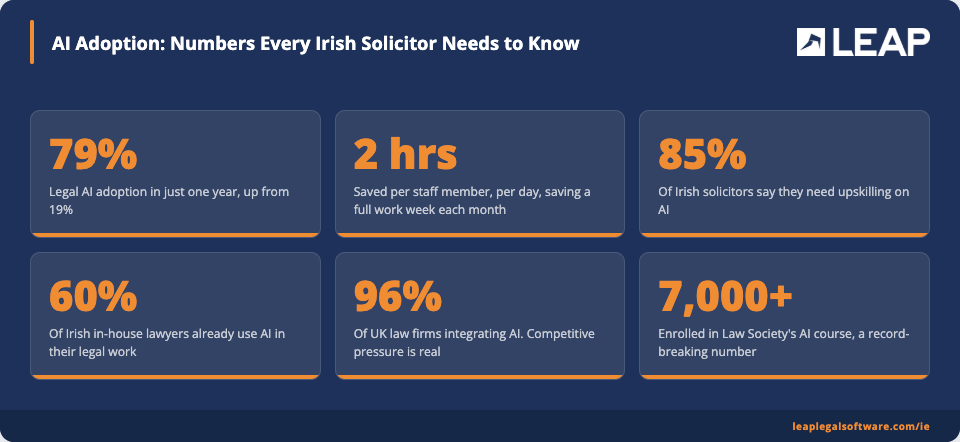
Legal AI adoption jumped from 19% to 79% in just one year. If you're an Irish solicitor still on the fence about AI, that stat should get your attention. Firms across the country are already saving up to 2 hours per day per staff member - that's an entire work week saved per person each month.
But here's the thing: adopting AI in legal practice isn't as simple as signing up to ChatGPT and feeding it your client files. The Law Society of Ireland published comprehensive guidelines in February 2025 making it crystal clear - consumer AI tools are not suitable for client data. Purpose-built legal AI is essential.
This guide covers everything you need to know. From the nine practical use cases that deliver measurable value, to the regulatory framework you need to follow, to the risks you absolutely must manage. Whether you're exploring AI for the first time or looking to deepen your firm's integration, you'll find actionable guidance here.
Ready to see how AI works inside a legal practice management system? and see the difference purpose-built legal AI makes.
Why AI Matters for Irish Solicitors Right Now
The idea that legal professionals are slow to adopt technology? Outdated. Over the past few decades, Irish practice has moved from paper-based workflows to cloud systems, digital research databases, and remote court hearings. AI is the next step in that evolution.
And the numbers tell the story.
There are 12,175 practising solicitors holding Law Society certificates and 3,071 barristers on the LSRA Roll. Of those solicitors, 85% say they need upskilling to understand AI. The demand is there - over 7,000 participants enrolled in the Law Society's online AI course, breaking all previous records.
Here's where it gets interesting: 60% of Irish in-house lawyers already reported using AI to power their legal work as of September 2024. Over 50% of in-house teams have established cross-functional AI governance teams. Corporate legal departments are moving faster than private practice.
And the competitive pressure from across the Irish Sea is real. 96% of UK law firms are now integrating AI into their operations. Irish practices that delay adoption risk falling behind on efficiency, pricing, and client expectations.
The gap between early adopters and everyone else is widening. Fast.
How Does AI Deliver Value in Irish Law Firms?
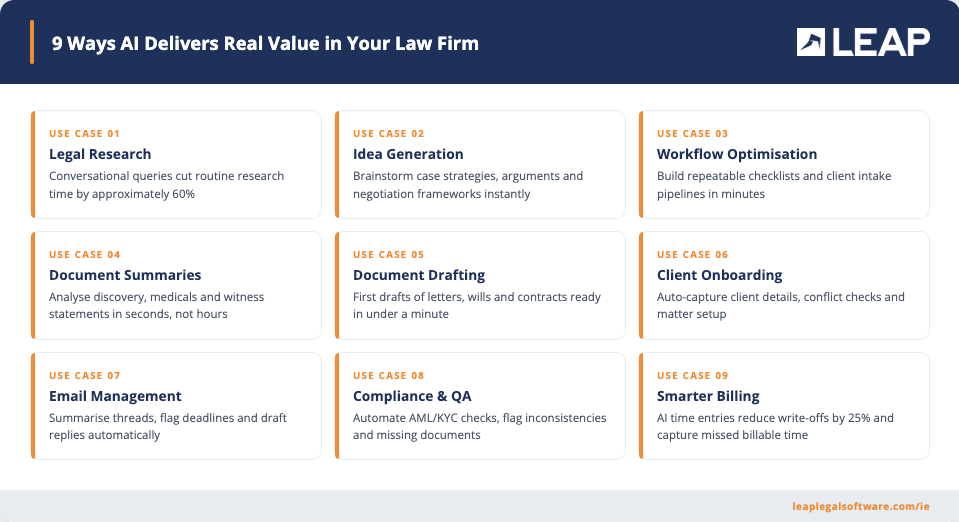
Here are nine practical ways your firm can integrate AI into daily workflows - with real results to match.
One critical note before we dive in: AI-generated content should always be treated as a draft. The Law Society of Ireland is clear that "the duty to ensure accuracy and reliability remains firmly with the solicitor" regardless of AI assistance. Always review before sharing with clients or courts.
1. Legal Research That Doesn't Eat Your Entire Afternoon
Traditional keyword searches only get you so far. Modern AI tools let you interact with legal databases conversationally, refining queries in real time. The Law Society guidance confirms AI is suitable for "summarising large volumes of information, including legal texts and documents" and "translating legalese into plain language."
But there's a catch. The Law Society explicitly warns that general-purpose AI tools are not suitable for "citing case law and precedents" or providing legal advice. You need purpose-built legal AI for research.
LEAP's LawY addresses this directly. When you submit a legal query, LawY generates an instant AI response that's then verified by an Ireland-based qualified solicitor. That human-in-the-loop approach means you get speed without sacrificing accuracy.
Firms using LawY report cutting research time by approximately 60% on routine queries.
2. Idea Generation and Strategic Planning
Stuck on a case strategy? Can't find the right angle for a legal submission? Generative AI is brilliant for brainstorming - and the Law Society explicitly endorses this as a "suitable" use case.
For complex litigation, AI helps you identify alternative arguments, anticipate counterarguments, and suggest procedural approaches. For transactional work, it generates negotiation frameworks and structures deal documentation.
The key: treat these outputs as a starting point. Apply your professional judgment, adapt to Irish law, and refine to your firm's standards. The productivity gains from breaking through that initial creative barrier are substantial.
3. Workflow Optimisation That Actually Sticks
Need a new client intake pipeline? A better case closing procedure? Start with AI. The Law Society notes AI is suitable for "creating checklists" - and that's just the beginning.
Give the AI general information about what you want to accomplish, take the initial output, refine it, and iterate. This accelerates work, improves delegation, and increases billable capacity. LEAP's workflow automation tools can then codify those optimised processes into your practice management system so they're repeatable.
4. Document Summaries in Seconds, Not Hours
This is where AI saves the most time. Solicitors and their teams spend enormous amounts of time summarising witness statements, medical records, discovery materials, case law, and client correspondence.
LEAP's Matter AI transforms this process. It analyses all documents and correspondence within a matter and delivers immediate answers. Ask a question, and Matter AI responds using only the data from that specific matter - keeping everything relevant and confidential.
Here's a real-world example: a solicitor handling a divorce matter used Matter AI to compare financial disclosures from both parties. The AI identified exactly where the financials disagreed within seconds - no manual item-by-item comparison needed. Hours of work completed in moments.
5. First Drafts That Are Actually Usable
AI-powered drafting tools generate first drafts of letters, contracts, pleadings, wills, and more - all tailored to specific client or matter details. The Law Society identifies "drafting documents" as a suitable AI use case.
LEAP Generator takes this further. It analyses your matter details and generates customised, professional-quality documents. Need a retainer agreement, letter to counsel, or court submission? Generator searches your firm's existing templates or drafts bespoke documents.
The result? Documents that previously took 30 minutes to prepare are ready for review in under a minute. Firms report reducing standard letter drafting time by 75%.
6. Faster Client Onboarding
AI-powered intake tools capture and pre-process client details, extract key information (names, dates, issues, potential risks), determine appropriate matter types, and assist with conflict checking - all before a solicitor reviews the file.
LEAP's integrated intake forms and Matter AI streamline converting client communications into structured matter data. Less manual data entry, fewer errors, faster time-to-engagement.
7. Email Management That Doesn't Drive You Mad
Email management is one of the biggest time drains in legal practice. AI transforms it by summarising lengthy threads, extracting action points, generating draft responses, spotting deadlines, and automatically filing correspondence to the correct matter.
This matters more than you might think. Litigation alone accounts for 35% of complaints to the LSRA about inadequate services. Better correspondence management directly reduces your risk.
8. Built-In Compliance and Quality Assurance
AI can automate AML/KYC data extraction, identify missing documents, flag inconsistencies, detect deviations from firm policies, and generate audit-ready matter notes.
This helps you maintain compliance with the Solicitors Accounts Regulations 2023, Irish GDPR requirements, and sector-specific regulations. The LSRA received 1,476 complaints in 2024 - up 14% from 2023 - and made 18 successful High Court enforcement applications. Proactive risk management has never been more important.
9. Billing That Captures What You've Actually Done
AI automates narrative time entries, extracts time justification from emails and documents, and distinguishes between billable and non-billable tasks.
Given that Section 150 of the Legal Services Regulation Act 2015 requires detailed costs transparency, AI supports more reliable billing processes. LEAP's AutoTime reveals exactly how your practice spends its time, helping you demonstrate value to clients.
Firms using AutoTime report a 25% reduction in write-offs and dramatically improved billing accuracy.
AI Applications by Practice Area
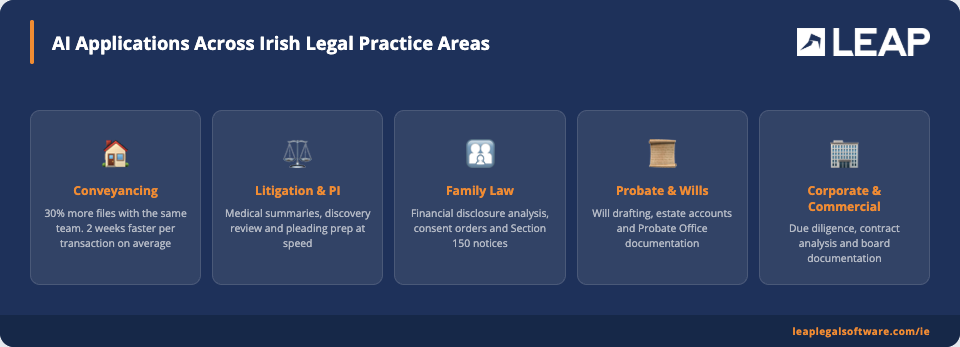
Different practice areas present different opportunities. Here's how AI fits into the work that dominates the Irish legal market.
Conveyancing: Where the Biggest Gains Are
92% of smaller Irish practices handle residential conveyancing, with approximately 61,000 residential transactions recorded annually. The LSRA has noted that Irish conveyancing remains "very much a paper-based system in a digital age." That's a massive opportunity for AI.
Here's what AI does for conveyancing:
Title review and analysis: Matter AI analyses title documents and identifies potential issues, missing information, or inconsistencies
Requisition management: AI drafts responses to requisitions using matter data, with solicitor review ensuring accuracy
Contract documentation: Generator creates customised contracts, special conditions, and amendments
Undertakings management: AI flags outstanding undertakings and assists with discharge documentation - critical given that bank complaints about solicitor undertakings drove the 14% increase in LSRA complaints in 2024
Firms report handling 30% more files with the same team, with turnaround time from instruction to completion dropping by two weeks on average.
Litigation and Personal Injury
Litigation is the largest category for LSRA complaints - 35% of inadequate services complaints, 33% of overcharging complaints. For the 79% of smaller practices engaged in personal injury litigation, AI is a game-changer.
AI handles medical record summaries, discovery review, witness statement drafting, quantum research, and pleading preparation. Matter AI can summarise extensive medical records, identify key injuries and treatments, and extract relevant dates for timeline construction.
Critical Warning: AI Citation Risks
The WRC decision in Oliveira v Ryanair DAC (October 2025) found AI-generated citations that were "not relevant, mis-quoted and in many instances, non-existent" - described as "egregious and an abuse of process." Always verify all case citations using authoritative legal databases before submission to any court or tribunal.
Family Law
Practised by 89% of smaller Irish firms, family law requires sensitivity and careful document handling. The LSRA specifically noted that "solicitors could improve their communications" in family law matters, particularly around costs transparency.
AI excels at financial disclosure analysis (comparing Forms of Means and flagging discrepancies), separation agreement drafting, consent order preparation, and preparing Section 150 costs notices.
Probate and Wills
82% of smaller practices handle probate. AI assists with will drafting and review, estate account preparation, beneficiary correspondence, Probate Office documentation, and asset tracking. LEAP's AI prompt templates include specific tools for will preparation, generating accurate first drafts tailored to client circumstances.
Corporate and Commercial
With 60% AI adoption among Irish in-house lawyers, corporate legal work is leading the profession. AI handles due diligence review, contract analysis, board documentation, regulatory monitoring, and transaction checklists.
The Risks You Need to Manage
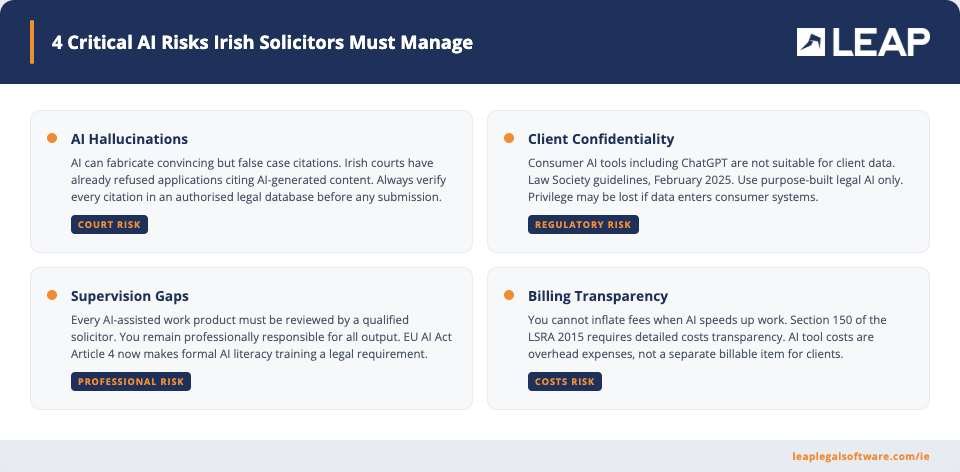
AI is powerful. But it's a tool, not a replacement for legal expertise. Here are the key risks and how to handle them.
Hallucinations Are Real - and Irish Courts Are Watching
Generative AI can produce convincing but factually incorrect or fabricated results. In legal practice, the stakes are high.
Irish courts have already flagged this. In Reddan v An Bord Pleanála [2025] IEHC 172, Mr Justice Barrett identified language "not familiar in Irish jurisprudence" with "all the hallmarks of ChatGPT." The application was refused on all nine grounds.
In Coulston v Elliott [2024] IEHC 697, the court warned that "the general public should be warned against the use of generative AI devices and programs in matters of law."
The Law Society notes there is "scope for the Irish Courts to impose sanctions in appropriate cases, including wasted costs orders and regulatory referrals."
Your mitigation checklist:
Verify all case citations using authoritative legal databases before any court submission
Use purpose-built legal AI with human verification features
Ensure qualified solicitor review of all AI-assisted work before client delivery or court filing
Treat AI outputs as first drafts, not finished products
Client Confidentiality Is Non-Negotiable
The Law Society's position couldn't be clearer: "Free and paid consumer GenAI systems are not suitable for securely handling personal data or client confidential data."
The guidance goes further, warning that "intentionally providing privileged communications to a free or paid GenAI model without appropriate safeguards in place may lose the benefit of privilege."
The Data Protection Commission has been active here too, obtaining injunctive relief against X/Twitter's use of EU user data for Grok training - the first use of this provision against AI training.
LEAP's AI tools address this directly: they never use client data to train AI models, and LawY can redact personally identifiable information from questions before processing.
Staff Supervision and the EU AI Act
A principal or supervising solicitor must review every work product from the firm - whether generated by AI or traditional means. The Law Society emphasises that solicitors are "professionally responsible for all legal work carried out within their office."
And here's what's new: the EU AI Act Article 4 literacy obligation, effective since February 2025, requires you to ensure a "sufficient level of AI literacy" among staff dealing with AI systems. Training isn't optional anymore.
Billing Transparency in an AI World
Can you charge the same fees if AI speeds up your work? Section 150 of the Legal Services Regulation Act 2015 requires detailed costs transparency. You must avoid inflating hours or fees unjustifiably.
The prevailing view is that AI tool costs are generally overhead expenses and shouldn't be separately charged to clients.
Here's the opportunity: many firms are shifting toward alternative fee arrangements. Fixed fees, value-based pricing, and hybrid models align fees with value delivered rather than time spent. AI enables you to handle larger volumes of high-value work efficiently, making these pricing models viable.
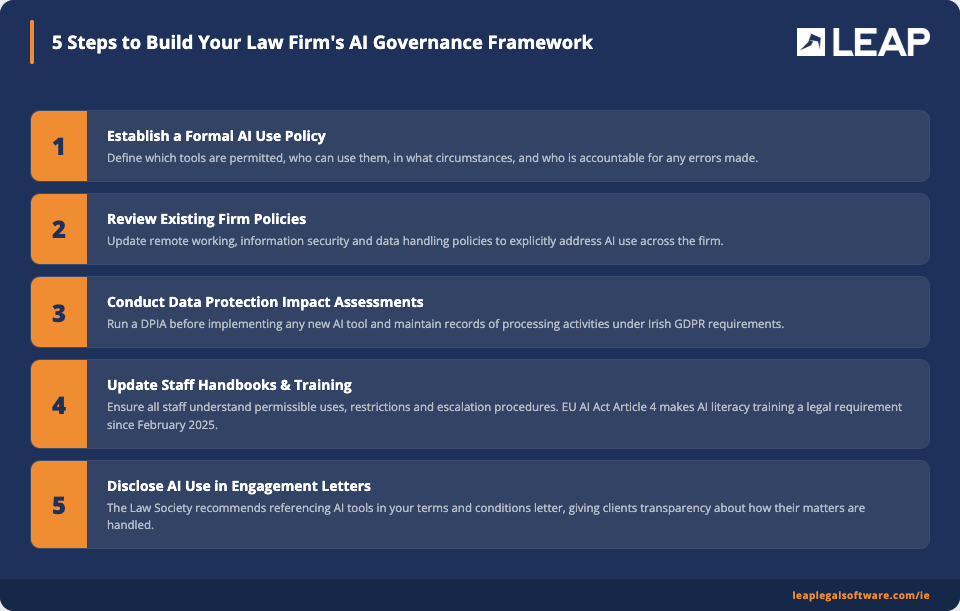
Building Your AI Governance Framework
Forward-thinking firms are putting governance in place now. The Law Society recommends referring to AI tool use in your terms and conditions letter to clients, offering transparency and the opportunity to raise concerns.
Five steps for effective AI governance:
Establish a formal AI Use Policy specifying which tools may be used, in what circumstances, by whom, and accountability for errors
Review existing policies to explicitly address AI use in remote work, information security, and data handling
Conduct Data Protection Impact Assessments for new AI implementations and maintain records of processing activities
Update staff handbooks so all team members understand permissible uses, restrictions, and escalation procedures
Disclose AI use in engagement letters where relevant, giving clients transparency about how their matters are handled
Getting Better Results: Effective Prompting for Solicitors
AI is a conversational tool. The better your prompts, the better your outputs. Here's what works.
Be specific about the outcome. Don't say "draft a letter." Say "draft a letter to opposing solicitors confirming completion date of 15 January 2025 for the sale of 123 Main Street, Dublin 4, requesting confirmation of undertaking discharge within 14 days."
Provide context. Include the legal area, jurisdiction, client circumstances, and constraints. The more context AI has, the more tailored the output.
Specify the perspective. "Draft as a senior associate in a Dublin conveyancing practice" produces very different output than a general request.
Iterate and refine. If the first output isn't right, adjust your prompt. Add constraints, clarify requirements, ask for specific changes. AI excels at iteration.
Save what works. Once you've developed effective prompts, save them as templates. LEAP includes a comprehensive library of purpose-built AI prompt templates for common legal tasks including instructions to counsel, client engagement letters, will summaries, completion statements, and affidavits.
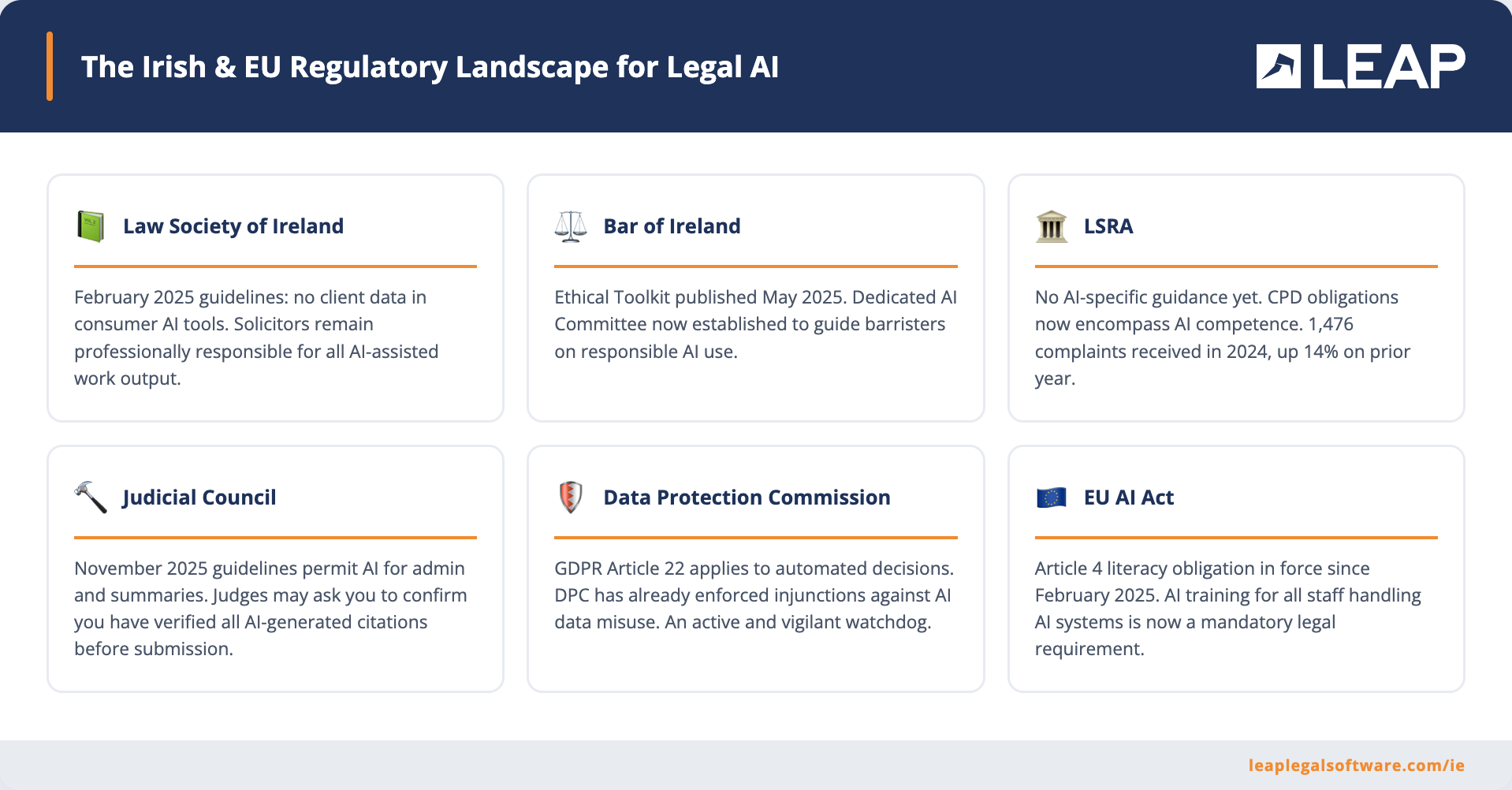
The Irish Regulatory Framework: Who Says What
Ireland has established clearer AI governance for legal professionals than many jurisdictions. Here's the landscape.
Law Society of Ireland
Published comprehensive Guidelines for the Use of Generative Artificial Intelligence in February 2025. Covers confidentiality (client data must not enter consumer AI systems), competence (solicitors remain responsible for all work), independence (AI cannot compromise professional judgment), and the duty not to mislead the court. The Law Society's Legal Tech Hub provides ongoing resources and CPD.
Bar of Ireland
Published its "Ethical Toolkit: Ethical Use and Use Cases for Artificial Intelligence" in May 2025. Established a dedicated AI Committee and has hosted events covering algorithmic bias, facial recognition, and sentencing considerations.
Legal Services Regulatory Authority
Has not published AI-specific guidance yet - a gap worth monitoring. Their Code of Practice (effective September 2024) requires undertaking continuing education "necessary to ensure an adequate level of knowledge and competence," which now encompasses AI.
Judicial Council
Published guidelines for judges in November 2025, permitting AI for summaries and administrative tasks but prohibiting use for legal research or analysis. Importantly for practitioners: legal representatives don't need to disclose AI use if "used responsibly" and "appropriately tested and verified." But judges may ask you to confirm you've verified AI-generated citations.
Data Protection Commission
Published guidance on "AI, Large Language Models and Data Protection" in July 2024. GDPR Article 22 automated decision-making rules create direct implications for legal AI use.
What's Coming: The Next Five Years for Legal AI in Ireland
2025-2026: Foundation Building
Expect significant uptake of AI training as the 85% of solicitors needing upskilling engage with Law Society programmes. Courts Service Practice Directions on AI use in submissions are likely. Early-adopter firms will establish competitive advantages through documented efficiency gains.
2026-2027: Regulatory Maturation
The LSRA is likely to issue AI-specific guidance. First Irish disciplinary cases involving AI misuse will establish precedent. Professional indemnity insurers will develop clearer positions on AI-related claims.
2027-2028: Market Transformation
AI becomes standard for competitive firms, similar to cloud computing today. The gap between Irish and UK adoption rates narrows significantly. Client expectations for AI-enabled efficiency become explicit in tender processes and panel reviews.
2028-2030: Integration and Innovation
Purpose-built legal AI tools become increasingly sophisticated, with better understanding of Irish legal terminology and precedent. End-to-end workflow automation deepens. The LSRA's conveyancing digitalisation agenda accelerates.
Take the Next Step
Irish legal practice is at an inflection point. Firms that embrace AI now are positioning themselves for a stronger future - more efficient processes, better results for clients, and the capacity to handle more high-value work without burning out their teams.
The key is choosing the right tools. Purpose-built legal AI that keeps client data secure, integrates with your practice management system, and includes human verification is fundamentally different from consumer AI.
LEAP's AI tools - Matter AI, LawY, and Generator - are purpose-built for Irish solicitors. They won the first-ever "Best Use of AI in Legal Tech" award at the International Cloud AI Awards in 2024. And all AI features are included in LEAP subscriptions at no additional cost.
and see how AI within LEAP can help your firm save up to 2 hours per day.
Frequently Asked Questions
Is it safe to use AI with client data in Ireland?
Consumer AI tools like ChatGPT are not suitable for client data. The Law Society of Ireland's February 2025 guidelines are explicit about this. Purpose-built legal AI tools like those within LEAP are designed to handle client data securely, never using it to train AI models and maintaining the same high-security standards as the practice management platform.Do Irish solicitors need to disclose AI use to clients or courts?
The Judicial Council guidelines (November 2025) state that legal representatives don't need to disclose AI use if it's "used responsibly" and "appropriately tested and verified." However, the Law Society recommends mentioning AI tool use in your terms and conditions letter. And judges may request confirmation that you've verified AI-generated citations.What are the biggest risks of using AI in legal practice?
Hallucinations (fabricated case citations and inaccurate legal content), client confidentiality breaches when using consumer AI tools, and automation bias where solicitors accept AI output without sufficient review. Irish courts have already refused applications and identified sanctions for AI misuse.How much time can AI save in a law firm?
LEAP users report saving up to 2 hours per day per staff member. Specific gains include 60% reduction in routine research time, 75% reduction in standard letter drafting time, and firms handling 30% more files with the same team.What does the EU AI Act mean for Irish solicitors?
The Article 4 literacy obligation, effective since February 2025, requires firms to ensure staff have a "sufficient level of AI literacy." This means formal AI training is no longer optional - it's a regulatory requirement.
Related Articles
:quality(82))
Discover how top AI tools are transforming Irish law firms. Compare Matter AI, LawY, and Generator with general AI options. Save 2+ hours daily with purpose-built legal AI.
:quality(82))
The Law Society’s recently published guidance, Mitigating AI Hallucinations, outlines several critical safeguards legal practitioners should adopt when using AI. Their message is clear: reduce the risk of incorrect or fabricated case citations (“hallucinations”) and ensure legal professionals maintain control over the advice and insights AI tools provide.
Ready to See Legal AI Working Inside a Real Irish Law Firm?
Stop experimenting with consumer AI. See how LEAP’s purpose-built legal AI saves up to 2 hours per day per staff member while keeping your firm fully compliant and secure.