Productivity
Beyond Productivity: The Human Impact of AI in Legal Practice
July 9, 2026 ・ 4 min read
:quality(85))
Drawing on my experience as a legal assistant in law firms, alongside my work creating digital content for wellbeing platforms and corporate clients, I have had a unique opportunity to observe two important trends: the growing focus on workplace wellbeing and the rapid rise of AI.
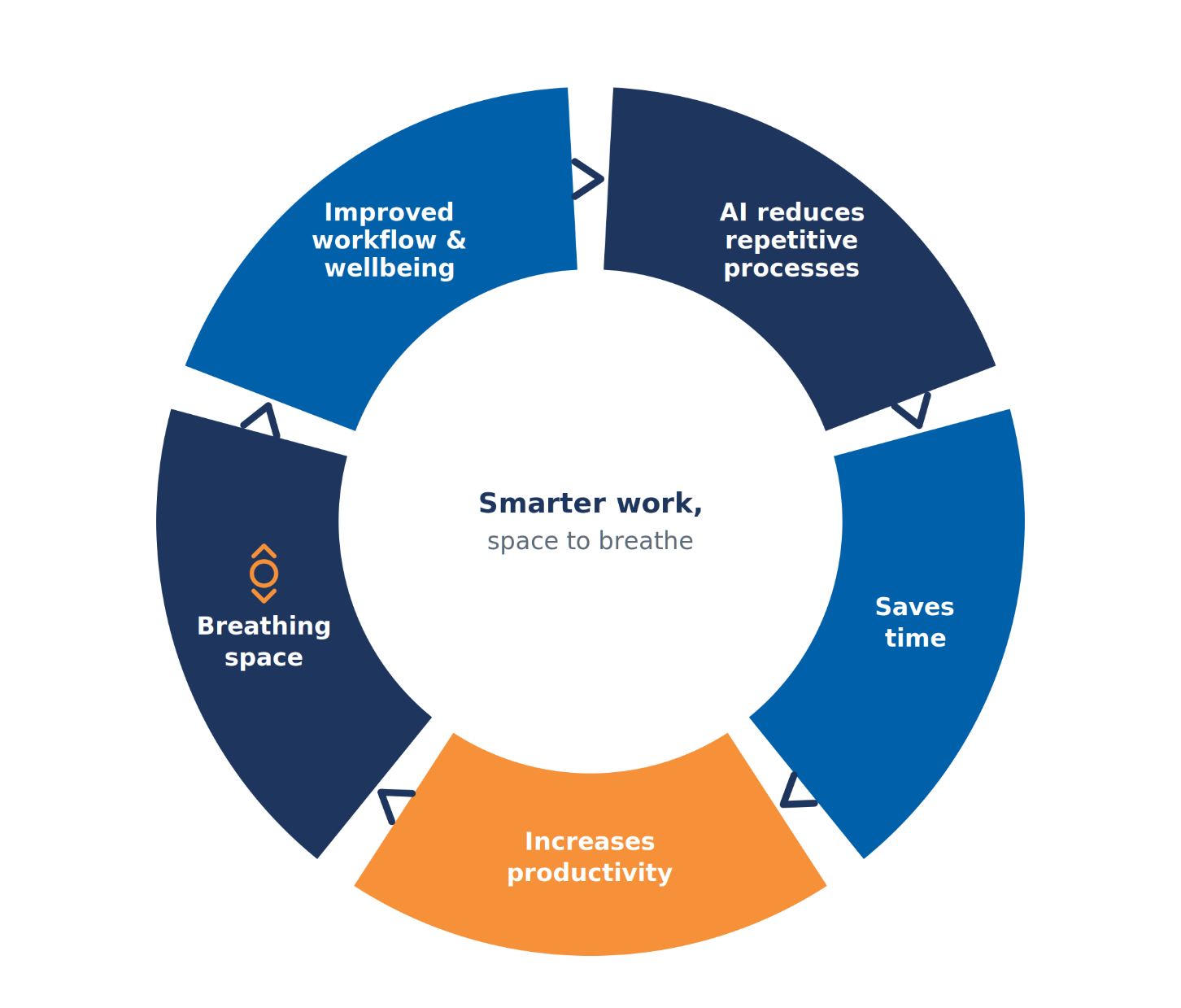
Over the past two years in particular, AI has emerged as a powerful tool that can help legal professionals work more effectively and efficiently. This is not because AI replaces expertise, judgement or professional knowledge; it does not. It can, however, reduce the time spent on repetitive and administrative tasks, allowing professionals to focus their energy on higher-value work that requires their legal insight and decision-making expertise.
As our understanding of AI evolves, we can shift the conversation from fear and a lack of trust in AI to a conversation that helps us determine the real opportunities that lie within it. One of these real opportunities is not to replace legal expertise but to enhance it, as AI has the potential to increase productivity and contribute to a more sustainable and balanced way of working.
The Growing Pressure on Legal Professionals
Legal professionals are already working within increasingly time-pressured days, in a world where instant access and rapid response times have become the expectation. As client demands and impatience continue to grow, firms need practical tools and content that help them work more efficiently, respond with confidence to increasingly complex workloads, and prevent administrative duties and repetitive tasks further reducing the time available for higher-value legal work.
Wellbeing Advice vs Workplace Reality
In my previous wellbeing work supporting professionals, one of the most common frustrations I heard from those experiencing work pressure and burnout was simply: “I don’t have time.” Many wanted to prioritise their wellbeing and reduce stress, but the reality of demanding workloads, caring responsibilities, financial pressures, and day-to-day life often left little space to do so. While wellbeing practices are valuable, they can become another source of pressure when someone is already overwhelmed. We cannot simply create more time, which is why practical solutions that reduce pressure and simplify daily work are so important. This is why I see the rise of AI as a positive opportunity. Used well, AI has the potential to reduce time-consuming tasks and help reintroduce breathing space into professional life. Of course, that time may often be filled with more work, but perhaps the starting point is to ask: what could I do differently if I had more time?
AI: Reducing Pressure, Improving Productivity
AI can support legal professionals in many ways:
Reducing workload pressure through automation of repetitive tasks.
Decreasing cognitive overload by organising, summarising and presenting information more efficiently.
Reducing decision fatigue by helping legal professionals process information more quickly.
Creating time for strategic work, which is often more engaging and rewarding than routine and time-consuming administration.
Supporting work-life balance by helping tasks be completed more efficiently within working hours.
Reducing stress associated with large volumes of information and tight deadlines.
How LEAP Brings AI Into Everyday Legal Work
This is exactly the kind of support we focus on at LEAP Legal Software. LEAP has AI built directly into the tools Irish firms already use every day, so the time saved flows back to the people doing the work. With LawY, solicitors can get verified answers to legal questions in seconds, while Matter AI surfaces instant answers from the documents and correspondence within a matter. Combined with automated document generation, these tools reduce the repetitive, time-consuming tasks that so often eat into the working day — helping to create the breathing space described above.
To explore this further, read our guide to AI in Irish legal practice and our overview of the best legal AI tools for Irish solicitors.
Closing Thought
As someone with a passion for both wellbeing and technology, I am fortunate to work in a role where the content I create can help support legal professionals in their day-to-day work. As we move further into the AI era, there is no doubt that technology will continue to transform the legal profession.
Whilst AI can help improve efficiency and automate routine tasks, it is important that we do not lose sight of the people behind the work. If used thoughtfully, AI has the potential not only to enhance productivity but also to create a more sustainable way of working. As client expectations continue to grow, let us ensure that wellbeing remains part of the conversation, so that burnout does not become the unintended consequence of progress.
About the Author
Caroline Meade is our dedicated Content Specialist for LEAP in Ireland, bringing a distinctive blend of legal industry knowledge and digital content expertise to the role.
She has hands-on experience as a legal assistant in firms of all sizes, with a focus on Conveyancing, Commercial, Corporate and Technology law, most recently at EY Law. Complementing her legal background, she has a strong background in digital content creation, having founded an online wellbeing platform and partnered with corporate clients, including Children’s Health Ireland, to deliver events and bespoke content in the mental health and wellness space.
Related Articles
:quality(82))
Explore how Irish legal professionals can maintain wellbeing and productivity through mindful habits, clear boundaries, and technology that supports smarter working.
:quality(82))
Covid has had a major impact on legal services, it has seen increased digitalisation across the profession and instilled the need for law firms to be more productive.
Bring AI Into Your Practice — Without Losing the Human Touch
LEAP Legal Software helps Irish law firms work smarter, reduce time spent on admin and create space for higher-value legal work. Discover how in-built AI can support both productivity and wellbeing in your firm.