Property
CPI rent adjustments: The questions you might have and how LEAP can help solve them


A CPI rent review calculation looks like a two-minute job. The formula is in the lease, the numbers are on the ABS website, and the answer is arithmetic. Then you have to decide which CPI series the lease uses, which quarters it relates to, whether the security deposit changes with the rent, and how you deal with the timing of the CPI data against the rent review dates. Each of those questions has to be answered before the maths means anything.
Disclaimer: The information provided in the articles in this section are of a general nature and should not be construed as specific advice or relied upon in lieu of appropriate professional advice. Whilst LEAP Legal Software uses commercially reasonable efforts to ensure the information in these articles is up to date at the time of publication, LEAP does not warrant their accuracy, currency or completeness and excludes all loss or damage howsoever arising (including through negligence) in connection with the information contained in these articles.
What is CPI?
The Consumer Price Index (CPI) is an index number published periodically by the Australian Bureau of Statistics (ABS) that measures inflation.
Many leases use it as the mechanism to automatically adjust rent at each review date (usually annually) which aligns the rent with what is happening in the economy at that time.
How do I actually calculate the increase using CPI?
Your lease will set out the specific process for adjusting the rent using CPI, but one of the most common formulas is:
New Rent = Current Rent × (Review CPI ÷ Base CPI)
The Review CPI is the CPI for the quarter immediately preceding the current review date set out in the lease and the Base CPI is the CPI for the quarter immediately preceding the previous review date (or, if there hasn’t been a review yet, the commencement date).
The hard part here isn't the maths at all - it's pinning down the right CPI series (is it a capital city, national or industry-specific series, and is it quarterly or monthly?) and working out which quarters to use based on your lease dates.
The ABS now publishes CPI monthly, does that change how I calculate?
You may have seen that since November 2025, the ABS has started publishing CPI on a monthly basis. Quarterly CPI is still published as well, but it is now calculated as the average of the three monthly figures. If your lease conditions specify that quarterly CPI is to be used then that is likely what should still be adopted (unless all parties have otherwise agreed to vary accordingly).
It may be that new leases will start to utilise monthly CPI adjustment processes in the future.
Does the security deposit need to be adjusted as well if the rent has changed?
Often, yes, and it's the step most easily missed. If the lease ties the deposit to an amount “equal to X months rent” then the lease provisions may allow for the security deposit amount to be adjusted as well. Whilst it might only be a small adjustment each year, it could end up being a significant jump over a long lease or where there is high CPI inflation across the life of the lease.
What if the adjustment wasn't applied on time?
This comes up more than you'd think, given the CPI data for the preceding quarter is often not yet available when the review date comes around or the parties don’t action the process straight away.
If the lease permits it, the landlord can recover the shortfall for the period the old rent kept being paid.
… Now the biggest question of all with the best answer:
My client wants assistance with the CPI rent calculation, can LEAP help me?
Let’s answer this with a scenario. Mrs Jones is the registered proprietor of 1 Main Street, which Mr Smith leases and operates his bakery from. Their lease commenced on 1 June 2024 for a term of 5 years, with annual CPI increases on each anniversary of the commencement date. That means the rent was already adjusted for CPI on 1 June 2025, and the current rent Mr Smith is paying (after that first annual CPI increase) is $1,000 a month (excluding GST).
Mrs Jones comes to you to help with the CPI rent adjustment on 15 June 2026, as she has just remembered it was due to increase and she had a lot of trouble doing it herself last time.
What is LeaseCalcs, LEAP's built in CPI calculator?
With LEAP you’ll be able to use the LeaseCalcs button which is in the top ribbon of your leasing matter types. It has a built in CPI calculator to help answer all of the above questions in practice.
LeaseCalcs will:
Handle either a quarterly or a monthly CPI process (meaning future leases that adopt monthly can still use it);
Once you input the current review date (in this instance 1 June 2026) and the previous review date (in this instance 1 June 2025), draw on the relevant CPI data for those periods; and
Calculate the CPI change as a percentage and the dollar rent increase per annum.
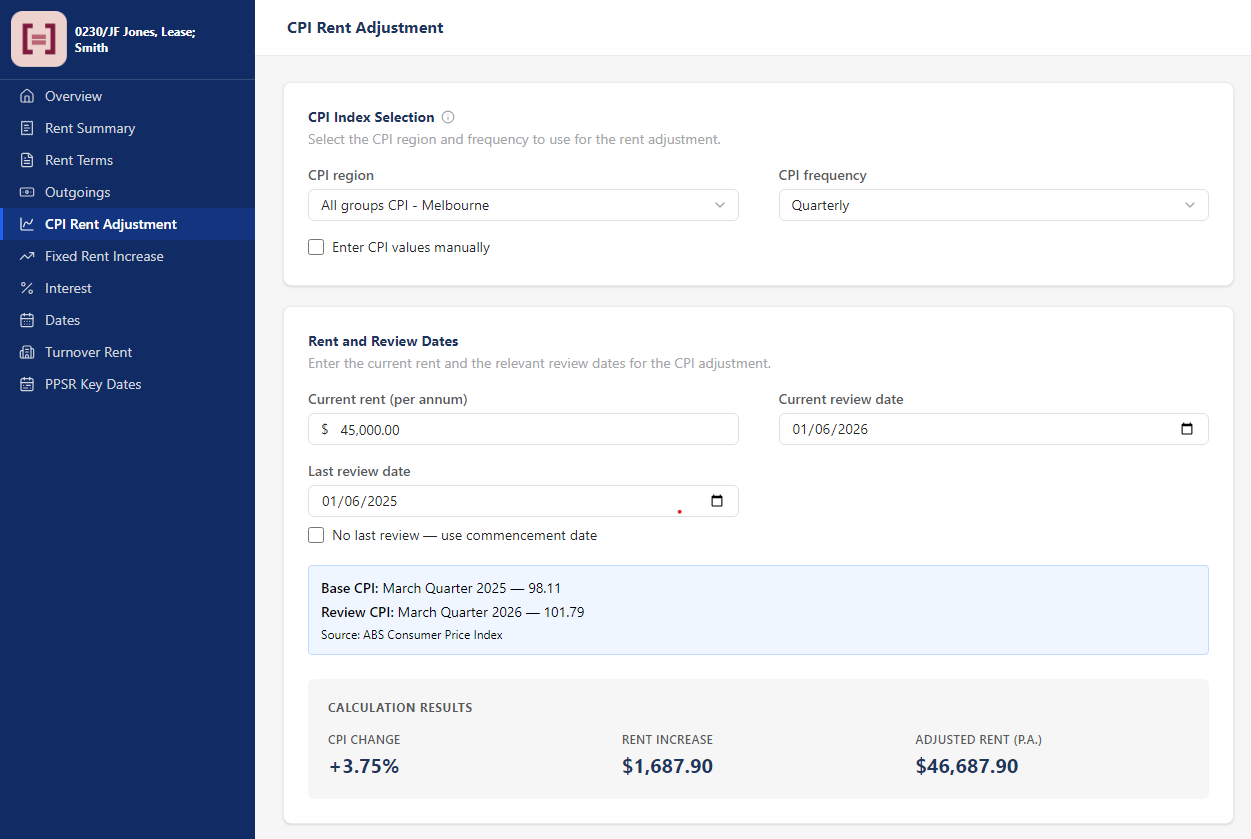 Image 1: LeaseCalcs calculates the CPI change and the new rent from the two review dates.
Because Mrs Jones came to you on 15 June 2026 when the adjustment date was the 1 June 2026, LeaseCalcs can also easily calculate the security deposit top-up and any backdated rent, all from a few simple inputs:
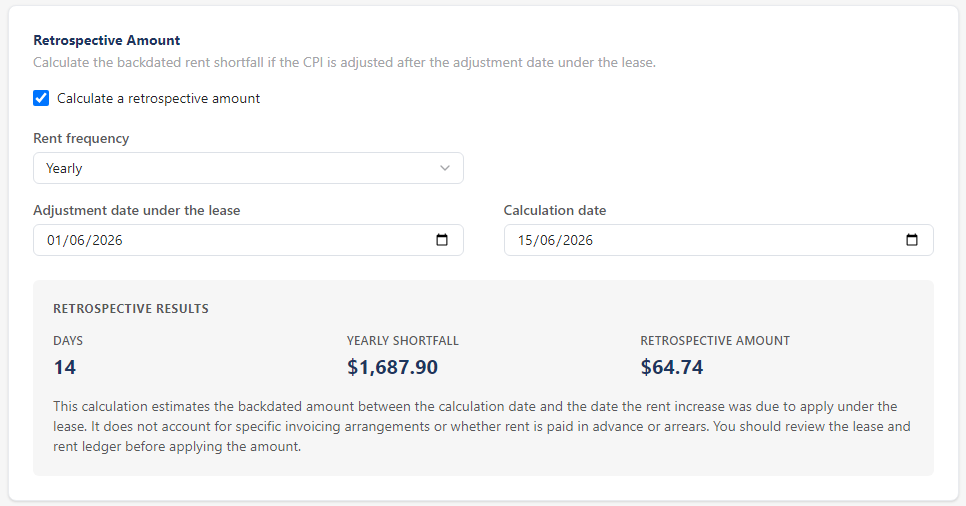 Image 2: The retrospective amount for the 14 days between the lease adjustment date and the calculation date.
CPI rent reviews are one of those tasks that look simple on paper but hide plenty of traps and can end up taking far longer than you anticipated.
About the writer

Related Articles

In Victoria, an amount the contract calls an adjustment can form part of the consideration for duty.

The ban started 10 August 2026. The harder question is the arrangements already on foot.

From 1 July 2026, property lawyers and conveyancers may start receiving reliance arrangement requests from real estate agents. Here's what they are, how they work, and what to check before agreeing.
Property matters, start to settlement
Pre-configured matter types, automated forms and precedents, and the settlement adjustments tool LEAP has been refining for 25 years.