Family
LEAP AI and the New FCFCOA Practice Direction
June 3, 2026 ・ 15 min read
:quality(85))
What the New FCFCOA Practice Direction Means for You
On 29 May 2026, the Federal Circuit and Family Court of Australia published its Practice Direction: Use of Artificial Intelligence (PD-AI). It applies to all court users - lawyers, litigants, and experts - and sets out clear expectations for how AI tools may be used in proceedings.
LEAP’s AI products are built for exactly this environment, and they comply.
The Practice Direction distinguishes between open AI (publicly accessible, no data controls) and closed AI (access-controlled, no public dissemination, no training on your data). LEAP’s AI features are closed AI, by definition and by design.
What the Practice Direction requires
The Practice Direction does not prohibit AI use. It requires court users to use AI responsibly, according to six core principles: integrity, accountability, accuracy, confidentiality and data security, safety, and education. It also places specific obligations around the protection of confidential and sensitive information, particularly in family law proceedings where Part XIVB of the Family Law Act 1975 (Cth) creates an indictable offence for unauthorised communication of proceedings.
The Practice Direction’s clearest warning is directed at open AI programs. These are tools like publicly available chatbots that operate without enforceable controls on how your data is used. LEAP’s AI tools have never been that.
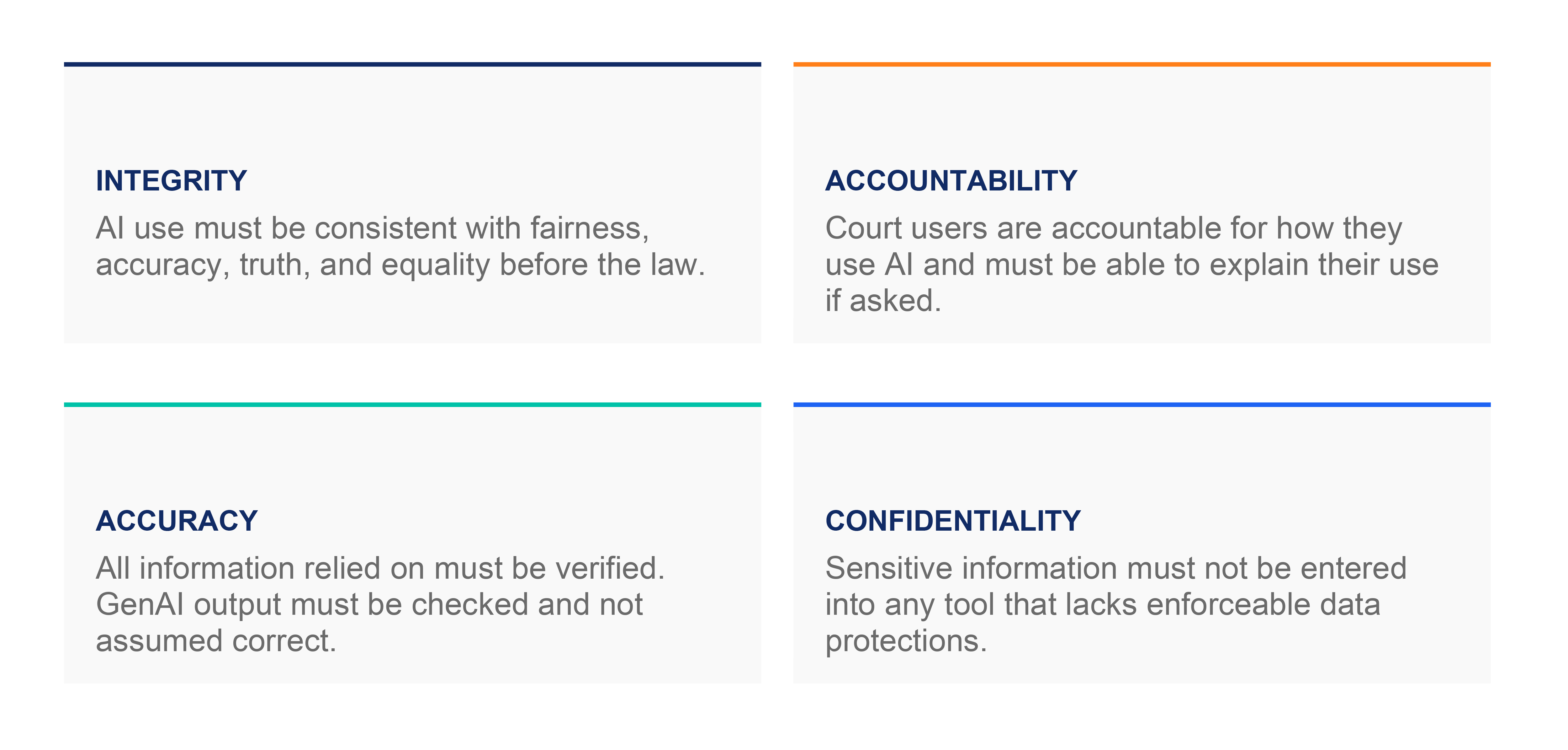
How LEAP meets each requirement
Closed AI - not open AI
All AI features available through LEAP operate as closed, enterprise-grade systems. LEAP holds enterprise-level agreements with foundational AI model providers (including OpenAI and Anthropic) that expressly prohibit client information from being used to train underlying models. Zero Data Retention policies ensure that no LEAP data or client information is stored by those providers following inference. Your clients’ information is not accessible to any other practitioner, party, or third party.
Confidentiality and Part XIVB compliance
The Practice Direction’s most urgent warning, and the concern raised in Helmold & Mariya (No 2) [2025] FedCFamC1A 163, is the risk that inputting court documents into an open AI tool may constitute communication of proceedings to the public under Part XIVB. LEAP’s position is clear: that warning is confined to open AI programs. LEAP’s features operate within a closed, confidential, non-training environment reinforced by:
Role-based access controls
AES-256 encryption at rest and HTTPS/TLS encryption in transit
Continuous monitoring and auditability
Prompt scoping, document-level filtering, and matter-based access controls
Enterprise-level contractual restraints preventing data from being used to train AI Model Providers
Client information and data is not exposed to any other practitioner or party. Information is processed transactionally on a session basis and is not retained post-inference by AI model providers.

Legal professional privilege
Privilege is not waived where information is disclosed confidentially to an agent or service provider for the dominant purpose of obtaining or providing legal services. LEAP maintains the same standard of data security across AI and non-AI workflows. The AI features are built to be uniform with the broader LEAP platform, so that their use is consistent with preserving confidentiality. You are not disclosing your clients’ information to the public, you are using a secure, matter-centric legal tool.
Accuracy and human oversight
The Practice Direction is unambiguous: GenAI output must be fact-checked and verified. LEAP aligns with this fully. Our features are designed to keep practitioners accountable - not to replace their judgement. Consistent with the views at [7] and [8] of Helmold & Mariya, LEAP maintains that any output produced by LEAP’s AI features must be independently checked by the practitioner. Where available:
Source referencing, traceability to documents, and verified answer systems (including LawY and Matter AI) actively support the verification process
Clear reminders and disclosures are provided where AI-generated content is involved
LEAP regularly audits the performance of underlying AI models for accuracy, combining internal audits with continuous monitoring to detect drift, inaccuracies and unreliable behaviour
Practitioner feedback is regularly considered and reviewed
Education and understanding
As set out at 3.3(f), the Practice Direction requires court users to educate themselves on the strengths, weaknesses, risks and limitations of AI and especially GenAI before using it. LEAP supports this through on-demand recordings, written resources, and training sessions for practitioners. We will continue to expand these resources as the landscape evolves, including further educational materials specifically addressing the Practice Direction.
Our products at a glance
Different LEAP products have different technical architectures. Here is a summary of the key data and hosting details relevant to the Practice Direction:
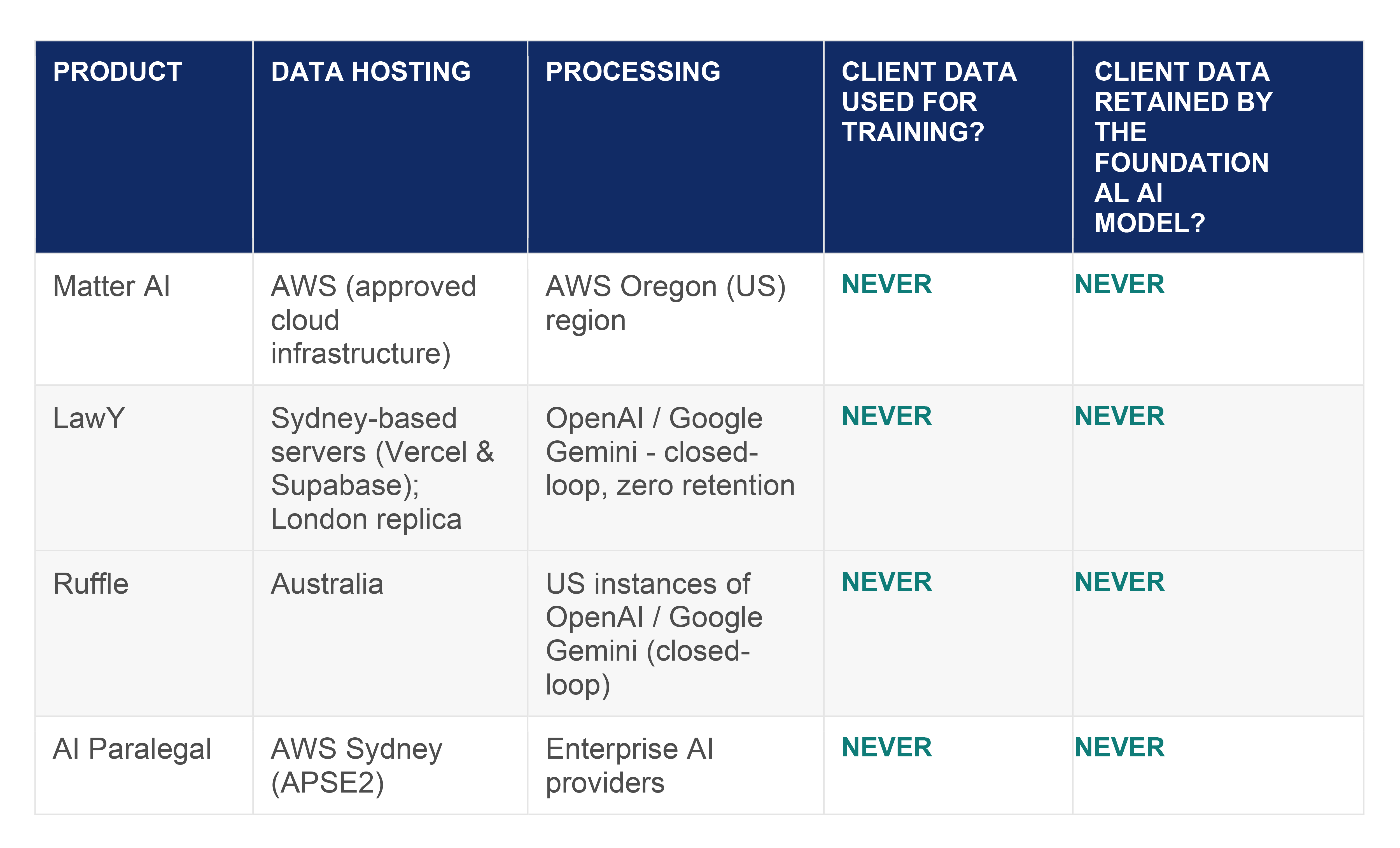
Some of LEAP’s features exclusive to family law also leverage AI to enhance functionality and improve workflows. These include but are not limited to Balance Sheet+, Parenting Calendar+ and our Calculators and Estimators. These AI-powered features are subject to the same strict security policies that govern the broader LEAP platform, to ensure confidential client information is protected and not used to train foundational AI models.
Full technical detail, certifications, and data processing agreements are available via the LEAP Trust Centre, the CORTO Trust Centre, and the LawY Trust Centre.
What practitioners still need to do
The Practice Direction places obligations on court users, not only on technology providers. LEAP’s closed architecture addresses the data and confidentiality requirements. But as the Practice Direction makes clear, and as we have always said, practitioners remain responsible for verifying AI output. No AI tool, however well-designed, substitutes for professional judgement.
Specifically, practitioners using LEAP’s AI features should:
Verify all output. Fact-check and proof-read any content produced by AI. Confirm that any references to legislation, case law, or textbooks are accurate and current. Use AustLII and the Federal Register of Legislation as reliable primary sources.
Ensure affidavit content reflects the witness’s own words. AI may assist in drafting, but affidavit material must express the witness’s own knowledge and experience in the witness’s own words. Exercise particular caution here.
Use NAATI certified translators. Where material requires translation from another language, a NAATI certified translator or interpreter must be used. You may not rely on tools such as Google Translate.
Provide experts with a copy of the Practice Direction. Lawyers engaging expert witnesses must provide them with a copy of the Practice Direction and ensure the expert certifies that it has been read.
Consider access to justice obligations. If a self-represented party is on the other side and you are using AI to manage your case efficiently, you should offer to undertake highly manualised tasks on their behalf, such as preparing a joint chronology.
Be prepared to account for AI use. If asked by the Court or by the other side, be prepared to explain whether AI was used, which tool was used, how the output was checked and supervised, and how the principles in the Practice Direction were observed.
Understand your tools’ terms of service. Familiarise yourself with the terms of service of the AI products and GenAI tools you use. LEAP will assist with resources to help practitioners understand the terms governing our products.
Commentary: Key observations from the LEAP AI Podcast
The following commentary reflects the most current thinking from the LEAP Family Law podcast ‘This Week in Family Law’ bonus episode on the Practice Direction released on 2 June 2026.
Overall assessment
This Practice Direction has been a long time coming. About a week after the NSW Supreme Court practice direction came into operation in February 2025, the chair of the FCFCOA judges’ AI committee publicly indicated this practice direction was imminent but there were differences of opinion between the judges, with strong views about the risks of AI in relation to confidentiality, loss of privilege, breach of Part XIVB, deep fakes, breach of copyright, and systemic biases. In the 16 months since, advances in AI have significantly improved how closed AI systems address those concerns.
What the FCFCOA produced has been worth waiting for. The Practice Direction is progressive and facilitative for practitioners who are enthusiastic about AI, and much less restrictive than some other practice notes we have seen, particularly the NSW Supreme Court direction from early 2025. It reflects an overall shift in attitude towards AI, particularly in recognising the difference between closed and open AI systems.
At [3.4] the Court acknowledges the significant benefit AI can have for efficiency, access to justice, reducing costs and enabling participation. The Practice Direction reinforces what practitioners who are responsibly using AI are already doing: verification, documenting how AI was used, taking ownership of the work generated by AI, and managing confidentiality effectively.
The green light for family law practitioners
This Practice Direction gives the green light for a progressive use of the advantages of AI in the practice of family law in Australia. Since LEAP has been offering AI-assisted products, we have emphasised at all times the importance of the lawyer in the loop. That is a central theme here. Many of the general principles that already exist in Uniform Codes of practice for lawyers are emphasised including the paramount duty to the court, the duty to act honestly and with integrity, the duty to protect confidentiality, and the duty to only allege facts that have a proper basis.
A point requiring clarification: clause 5.4(b) and ‘chat history’
One point that warrants clarification is clause 5.4(b), which directs court users to “disable the chat history and web search access in GenAI Chatbots if this option is available.” There is a meaningful distinction that the Practice Direction does not address: the difference between chat history and memories.
Chat history refers to a user’s ability to view their own previous conversations, this is useful for their own records and for documenting what and how AI was used. Memories, by contrast, refers to the AI building a profile about the user: their role, their language, their preferences. These are functionally distinct, and it would be useful for the Court to clarify whether the instruction at 5.4(b) is directed at one or both of these features.
We will be seeking clarification on this point and will update our guidance when available.
What LEAP will produce to assist
Educational materials specifically addressing the Practice Direction and how to comply
Resources to assist practitioners understand the terms of service of LEAP’s AI products
Webinar content addressing the strengths, weaknesses, risks and limitations of AI and especially GenAI
A dedicated resource on the AI Practice Direction for expert witnesses
For more information on the FCFCOA Practice Direction: Use of Artificial Intelligence, listen to our 2 June 2026 episode of our Podcast Series ‘This Week in Family Law’.
LEAP is ready and we are here to help you be ready too.
The FCFCOA Practice Direction reflects a maturing understanding of AI in legal practice and we welcome it. The distinction it draws between open and closed AI validates the architecture we have built from the beginning: secure, confidential, purpose-built for the legal profession.
We will continue to monitor guidance from the Courts and update our products, resources, and documentation accordingly. More detail on each of these topics, including technical specifications, is available through our Trust Centre pages.
*This article is provided for general information purposes and does not constitute legal advice. Practitioners should seek independent legal advice where required.
:quality(82))
Discover what LEAP can do for Family Lawyers