AI
The Best Legal AI Tools for UK Solicitors: The Complete Guide for Law Firms
December 29, 2025 ・ 15 min read
:quality(85))
Artificial intelligence adoption among UK solicitors has reached a critical inflexion point. Recent industry research shows 61% of UK lawyers now use generative AI in their daily work - a dramatic increase from 46% in January 2025. From the City of London's Magic Circle firms to High Street practices across Manchester, Birmingham, and Edinburgh, solicitors are turning to legal AI tools to address mounting pressures: crushing billable hours targets, rising client expectations, and intensifying SRA compliance requirements.
Yet with dozens of AI solutions flooding the market, UK solicitors face crucial questions: which tools actually deliver measurable results whilst maintaining SRA compliance and protecting client confidentiality? And perhaps more importantly, how can firms avoid the AI hallucination crisis that has already led to sanctions in 18 documented UK cases?
This guide cuts through the noise. After analysing adoption data from 2,700+ UK law firms and evaluating platforms against SRA regulatory standards, we've identified the best legal AI tools that matter most for British solicitors.
Quick summary: The essential AI toolkit for UK solicitors
Matter AI - Best integrated legal AI for UK solicitors ⭐⭐⭐⭐⭐
LawY - Top AI legal research with qualified solicitor verification ⭐⭐⭐⭐⭐
LEAP Generator - Best AI document drafting tool for UK legal practice ⭐⭐⭐⭐⭐
What UK solicitors need in legal AI tools
Before evaluating specific platforms, UK law firms must consider these critical requirements - particularly given SRA regulatory obligations and the unique challenges of British legal practice.
UK jurisdiction expertise and regulatory compliance
Understanding English and Welsh law, Scottish law variations, and Northern Ireland procedures isn't optional - it's fundamental. With three distinct UK legal systems and post-Brexit regulatory changes, AI tools must demonstrate deep knowledge of British legal frameworks. More critically, they must align with SRA Standards and Regulations, particularly Rules 3.2 (competent service) and 8.1 (protecting client confidentiality).
The SRA's Risk Outlook Report explicitly warns that AI "does not have a concept of truth" - following tribunal cases where AI-generated fabricated case citations. UK solicitors cannot "trust AI to judge its own accuracy," making human verification essential.
Recent regulatory developments (2025): The SRA has intensified its focus on AI governance, conducting innovation events throughout 2025, emphasising adequate supervision requirements and workforce upskilling. The Law Society's May 2025 guidance has effectively codified AI literacy as baseline professional competence - with the Judicial Office clarifying that whilst courts will forgive litigants-in-person for AI errors, they expect near-perfection from regulated lawyers.
The AI hallucination crisis: What UK solicitors must know
Recent data reveals a sobering reality: 18 documented UK cases of AI-generated fabricated legal citations have emerged, with similar incidents occurring globally at an alarming rate. In July 2025 alone, over 50 cases worldwide involved fake legal authorities generated by AI tools.
The landmark UK case Ayinde v London Borough of Haringey [2025] EWHC 1383 (Admin) established clear judicial expectations: responsibility for accuracy never transfers to the machine. Sanctions for AI hallucinations have included:
Monetary penalties
Disciplinary referrals to regulatory bodies
Public reprimands
Disqualification from cases
Required notification to all current clients
Critically, these incidents aren't limited to junior solicitors or small firms - experienced attorneys at reputable firms have fallen victim despite having AI policies and compliance frameworks in place. The Bar Council's January 2024 warning proved prescient: blind reliance on AI risks incompetence or gross negligence.
Why this matters for your firm: General AI tools like ChatGPT lack verification mechanisms, making hallucinations inevitable. This makes human verification by qualified legal professionals non-negotiable for professional legal work - a requirement that fundamentally shapes which AI tools UK solicitors can safely use.
Data security that satisfies UK GDPR and SRA requirements
Client confidentiality represents a non-negotiable obligation under SRA principles. AI tools must provide:
UK GDPR compliance (post-Brexit regulations)
Secure data processing within trusted jurisdictions
Clear data retention and deletion policies
Protection against using client data for model training
Transparency about data transfers to third parties
With 75% of UK solicitors citing data security as their primary AI concern, this requirement determines whether tools are viable for professional legal work. The SRA's guidance emphasises solicitors must understand where data goes and how it's processed - making external AI platforms architecturally problematic for client work.
Seamless integration with existing legal workflows
UK law firms can't afford disruption to client service. Effective AI tools must integrate with:
Practice management systems already in use
Microsoft Office applications (used by 98% of UK firms)
Legal accounting software meeting SRA Accounts Rules
Document management systems
Time recording and billing platforms
The average UK solicitor bills only 2.6 hours per 8-hour working day - they cannot spare time wrestling with disconnected systems. Recent research shows 54% of AI-using solicitors measure success by time saved, with firms abandoning "no performance metrics" approaches (dropping from 26% to just 19% in 2025).
Cost effectiveness for small to mid-sized UK practices
With 44% of UK solicitors facing client pressure to reduce fees whilst overheads continue rising, cost scrutiny intensifies. Value propositions must demonstrate:
Clear ROI through quantified time savings
Transparent pricing (not hidden per-use fees)
Scalability from sole practitioners to 100+ lawyer firms
Inclusive feature sets (not tiered paywalls for essential functions)
Small firm barriers identified: SRA research from June 2025 reveals that whilst 82% of small firms agree technology helps provide better value, 96% identify barriers to adoption:
52% struggle to identify the right technology
72% worry about investing in tools that become outdated
Only 21% have been approached directly by tech providers
Many feel overwhelmed by options or find nothing suitable
Lack of time, technical knowledge, or confidence to choose
For sole practitioners and small firms (under 4 partners, sub-£400k turnover), integrated solutions that eliminate these barriers prove essential.
Human verification safeguards for professional work
The SRA requires solicitors to remain "responsible and accountable" for all work product, including AI-assisted outputs. Best-practice tools provide:
Built-in review workflows before client delivery
Audit trails showing human oversight
Verification by qualified legal professionals
Clear flagging of AI-generated content requiring review
This "human in the loop" requirement isn't optional - it's a professional obligation for UK solicitors. Research shows 88% of solicitors using legal-specific AI with human verification feel more confident in outputs compared to general AI tools.
UK-based support and training resources
When implementing AI tools, UK firms need:
Support teams' understanding of British legal practice
Training materials using UK legal examples
Response times during UK business hours
Knowledge of SRA compliance requirements
Understanding of English, Welsh, and Scottish law differences
How AI is transforming legal billing models in the UK
One of 2025's most significant developments is AI's impact on traditional billing structures. 47% of UK lawyers now believe AI will transform how firms bill for services - up from 40% earlier in the year. Among law firm leaders, this rises to 55%, with general counsel at 49%.
The billable hour under pressure
AI creates a fundamental tension: it reduces the time required to complete work, but the value of that work - particularly legal advice - remains unchanged. Clients increasingly expect lower fees when AI delivers quicker results, forcing firms to reconsider hourly billing models that have dominated for decades.
Industry data reveals:
56% of AI-using lawyers redirect saved time to increase billable work
53% use time savings for better work-life balance
Over 20% report improved mental health from AI efficiency gains
Large firms focus on commercial gains, small firms prioritise wellbeing
Alternative pricing models that firms are testing
Forward-thinking UK firms are exploring new billing approaches:
69% considering fixed fees by matter type
44% testing retainer arrangements
31% implementing flat fees for specific services
32% interested in dynamic pricing based on complexity and risk
32% exploring bundled services (AI tools + expert review)
Firms are also shifting toward:
Self-serve products combining AI with legal support
Managed service solutions bundling technology with advice
Subscription pricing reflecting AI's role in service delivery
Outcome-based pricing focusing on results rather than time
Client expectations for AI-enabled work
The transformation extends beyond firm economics to client demands:
60% of legal professionals report clients now expect technology use
Clients demand faster delivery without cost increases
Transparent pricing for standardised work is increasingly expected
Clients seek added value from expertise beyond what AI can provide
As one industry insight notes: clients increasingly expect high-value professional services to provide advice that cannot be easily gleaned from readily available search tools, including AI-powered ones.
Implications for UK solicitors: Firms must articulate value beyond time spent, demonstrate expertise AI cannot replicate, and develop pricing models reflecting efficiency gains whilst maintaining profitability. This represents a fundamental shift in how UK legal services are packaged and sold.
AI skills as a career imperative for UK solicitors
Beyond firm economics, AI competence has become critical for individual career advancement. Recent data reveals:
Talent retention risks:
18% of private practice lawyers would consider leaving firms failing to invest adequately in AI
19% of in-house counsel share this view
26% of lawyers at large firms would consider leaving over AI investment failures
Career advancement concerns:
39% of private practice lawyers believe failing to engage with AI would harm careers
49% of in-house counsel share this concern
AI proficiency is rapidly becoming an expected competency for progression
The cultural challenge: Research shows many solicitors worry that using AI will be seen as "cutting corners." Firm leaders must give teams permission to use it, experiment with it, and talk about it openly to overcome this stigma and prevent talent loss to more progressive competitors.
Comprehensive legal AI Tools comparison for UK solicitors
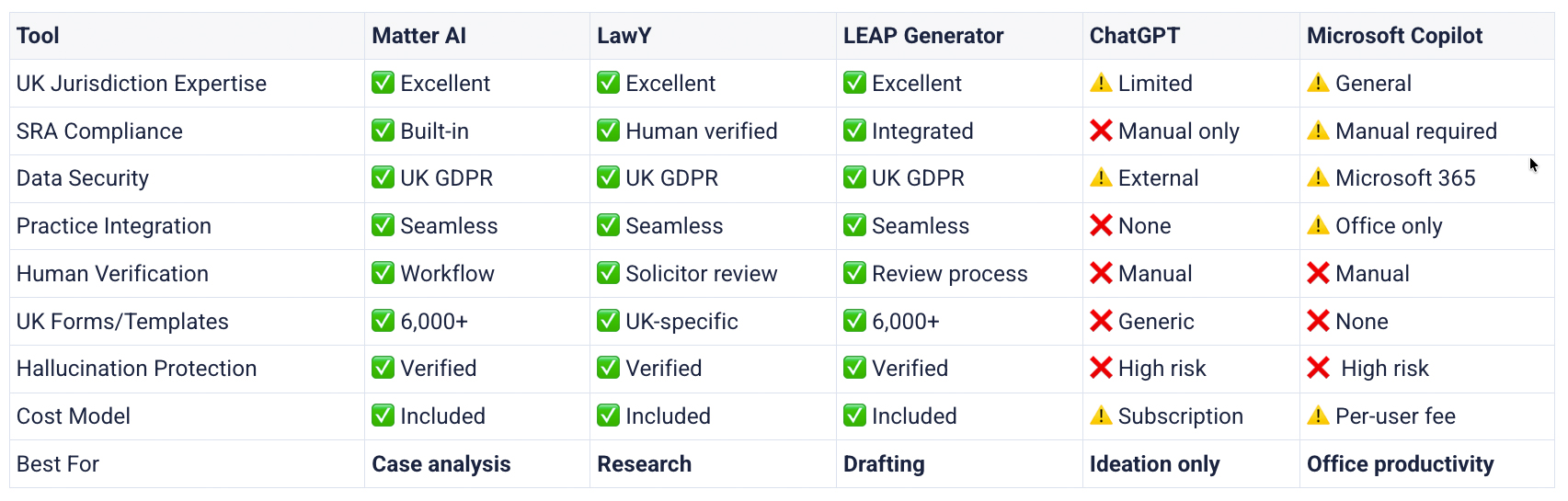
Tool | Matter AI | LawY | LEAP Generator | ChatGPT | Microsoft Copilot | |
|---|---|---|---|---|---|---|
UK Jurisdiction Expertise | ✅ Excellent | ✅ Excellent | ✅ Excellent | ⚠️ Limited | ⚠️ General | |
SRA Compliance | ✅ Built-in | ✅ Human verified | ✅ Integrated | ❌ Manual only | ⚠️ Manual required | |
Data Security | ✅ UK GDPR | ✅ UK GDPR | ✅ UK GDPR | ⚠️ External | ⚠️ Microsoft 365 | |
Practice Integration | ✅ Seamless | ✅ Seamless | ✅ Seamless | ❌ None | ⚠️ Office only | |
Human Verification | ✅ Workflow | ✅ Solicitor review | ✅ Review process | ❌ Manual | ❌ Manual | |
UK Forms/Templates | ✅ 6,000+ | ✅ UK-specific | ✅ 6,000+ | ❌ Generic | ❌ None | |
Hallucination Protection | ✅ Verified | ✅ Verified | ✅ Verified | ❌ High risk | ❌ High risk | |
Cost Model | ✅ Included | ✅ Included | ✅ Included | ⚠️ Subscription | ⚠️ Per-user fee | |
Best For | Case analysis | Research | Drafting | Ideation only | Office productivity |
1. Matter AI - Best overall legal AI for UK solicitors
⭐⭐⭐⭐⭐ (5/5 stars)
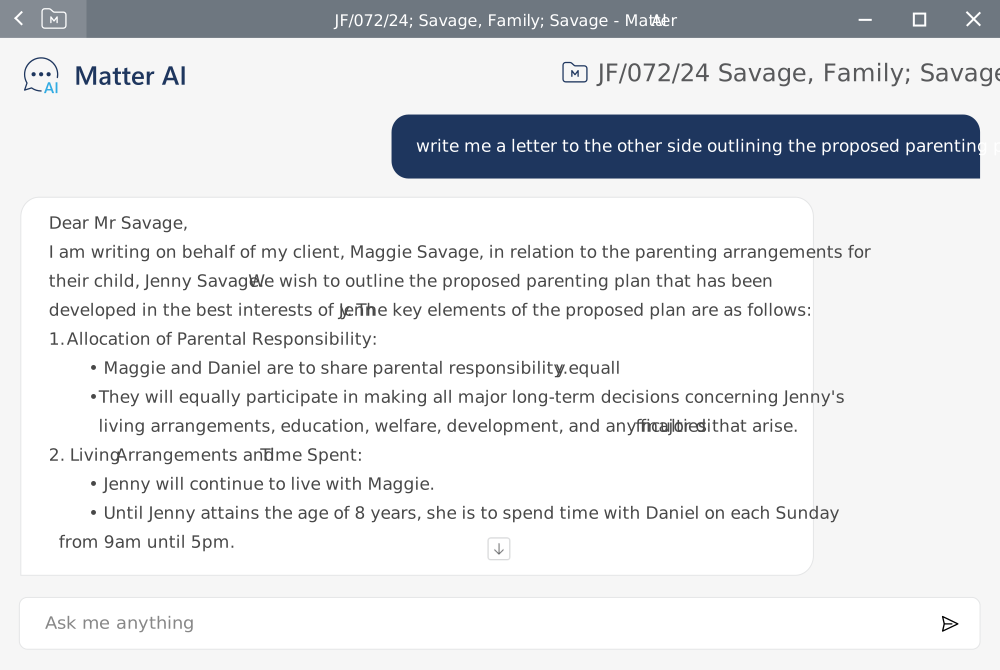
Matter AI tops our rankings as the most effective legal AI tool for UK solicitors. This context-aware AI assistant transforms how British law firms interact with case information, enabling solicitors to query their files conversationally whilst maintaining complete SRA compliance.
Overview: AI that understands your UK legal practice
Matter AI represents a fundamentally different approach to legal AI. Rather than operating as a separate platform requiring data exports, it integrates directly into your practice management system. This means UK solicitors can interrogate case files, correspondence, and documents using natural language - all within their existing secure environment.
Ask "Has the claimant filed a defence in the Smith litigation?" and Matter AI searches through the entire matter file to provide an accurate answer sourced directly from your documents. No manual searching through emails, no reviewing multiple file notes, no wasted billable time.
For UK solicitors managing 40-60+ active matters simultaneously, this capability alone delivers transformative efficiency gains.
Key features addressing UK solicitors' needs
Contextual answers from secure UK case files
Matter AI analyses all documentation within a LEAP matter - attendance notes, correspondence, court documents, contracts, and supporting files. When you ask about settlement negotiations, upcoming hearings, or outstanding requisitions, it retrieves precise information from your actual case data.
This addresses a critical pain point for UK solicitors: the average practitioner spends 2.1 hours daily searching for information across disconnected systems. Matter AI eliminates this overhead, converting dead time into billable hours.
Instant chronology for UK court proceedings
British legal practice demands meticulous chronologies for court bundles, litigation timelines, and transactional completions. Matter AI automatically identifies key dates, procedural steps, and critical events within case files - generating chronologies that would otherwise require hours of manual review.
For litigation solicitors preparing for Crown Court or High Court proceedings, this feature alone justifies adoption. Instead of spending 4-6 hours compiling chronologies manually, solicitors receive accurate timelines in minutes.
Integrated workflow maintaining SRA compliance
Unlike standalone AI tools requiring data exports (creating confidentiality risks), Matter AI operates entirely within your secure practice management environment. Client information never leaves your system. There's no uploading sensitive documents to external platforms, no risk of inadvertent disclosure, and no complicated data processing agreements.
This integration-first approach aligns perfectly with SRA obligations around client confidentiality and data protection - eliminating the compliance headaches that plague general-purpose AI tools.
Enhanced client service meeting UK expectations
With 68% of UK clients demanding after-hours responsiveness and 43% preferring website communication, solicitors face mounting pressure to provide faster, more accurate updates. Matter AI enables immediate responses to client queries: "What's the status of my conveyancing purchase?" receives an instant, accurate answer drawn from the matter file.
For High Street practices competing against online conveyancing services and alternative business structures, this responsiveness advantage proves critical for client retention.
Integration within UK legal practice management
Matter AI forms part of LEAP's comprehensive cloud platform - used by one in three UK law firms. This deep integration means:
Secure access: All data remains within your SRA-compliant system
No data migration: Existing matter information is immediately accessible
Automatic updates: New correspondence and documents are instantly incorporated
Audit trails: Complete records of AI interactions for file compliance
UK templates: Works with English, Welsh, and Scottish legal forms
For UK solicitors concerned about AI security risks, this controlled environment addresses the fundamental anxiety: client data never leaves your protected system.
Best for: UK solicitors wanting AI capabilities integrated within their existing practice management system without creating new security vulnerabilities or compliance risks.
Pricing: Included with LEAP subscription - eliminating per-query fees or usage-based charges common with standalone AI tools. [Contact LEAP for pricing details]
Results: UK firms report 90 minutes average daily time savings on case information retrieval - equivalent to 7.5 hours weekly or 375 hours annually per solicitor.
2. LawY - Best AI legal research assistant for UK solicitors
⭐⭐⭐⭐⭐ (5/5 stars)
LawY distinguishes itself as the only legal AI research tool combining instant AI-generated answers with verification by qualified UK solicitors. This hybrid approach directly addresses the SRA's warning about AI accuracy - providing the speed of artificial intelligence with the reliability of human legal expertise.
Overview: AI research with qualified solicitor verification
Legal research represents a significant overhead for UK solicitors. The average practitioner spends 7 hours weekly researching case law, statutes, and procedural requirements - time that's difficult to bill as clients expect solicitors to simply "know the law."
LawY transforms this dynamic. Ask any legal question - from "What are the time limits for possession proceedings under the Housing Act 1988?" to "How do Scottish Sheriff Court procedures differ from English County Court?" - and receive researched answers within seconds.
The critical difference: LawY's responses can be reviewed by practising UK solicitors before you rely on them professionally. This verification step eliminates the hallucination risk that has led to UK tribunal sanctions for solicitors who trusted AI-generated fake citations.
Why LawY's verification matters: The hallucination crisis
With 18 documented UK cases of fabricated AI citations and sanctions, including monetary penalties, disqualification, and disciplinary referrals, the verification question isn't academic - it's a professional liability issue.
LawY's human verification by qualified UK solicitors provides:
Confirmation that case citations are genuine (not AI hallucinations)
Legal accuracy and currency verification
Relevance to your specific jurisdiction
Identification of gaps or qualifications
Professional accountability you can evidence to the SRA
This transforms AI research from "helpful but risky" to "professionally reliable" - addressing the Bar Council's warning that blind reliance on AI risks incompetence.
Key features for UK legal research
Instant answers across English, Welsh, and Scottish law
LawY's knowledge base encompasses the full breadth of the UK legal system:
English and Welsh law (primary jurisdiction for most UK solicitors)
Scottish law variations (critical for Edinburgh and Glasgow practices)
Northern Ireland legal frameworks
Post-Brexit regulatory changes
UK statutory instruments and case law back to 1865
Ask about the Limitation Act 1980, the Consumer Rights Act 2015, Scottish pursuer rights, or Crown Court procedures - LawY provides accurate, jurisdiction-specific guidance.
Human verification by qualified UK solicitors
This represents LawY's revolutionary feature. After receiving an AI-generated answer, you can submit it for review by practising UK solicitors who verify:
Legal accuracy and currency
Relevance to your specific jurisdiction
Completeness of the response
Identification of any gaps or qualifications
Confirmation that case citations are genuine (not AI hallucinations)
For UK solicitors operating under SRA competence obligations, this verification transforms AI research from "helpful but risky" to "professionally reliable."
Expanding knowledge base with UK legal updates
LawY's database continuously incorporates:
Latest Court of Appeal and Supreme Court judgments
New legislation and statutory instruments
Updates to SRA Standards and Regulations
Procedural rule changes across UK jurisdictions
Law Commission reports and consultations
The system learns from solicitor feedback - when verifiers correct inaccuracies or add nuance, LawY's future responses improve. This creates a virtuous cycle where the tool becomes progressively more reliable for UK legal research.
Addressing SRA compliance concerns ethically
The SRA explicitly states solicitors "must not trust AI to judge its own accuracy." LawY's verification model directly addresses this guidance - providing a documented review process showing appropriate professional oversight.
For risk-averse UK firms concerned about AI liability and professional indemnity coverage, this human-in-the-loop approach satisfies both SRA expectations and insurer requirements.
Integration within secure UK practice management
Like Matter AI, LawY operates within the LEAP platform rather than as an external service. This means:
Research occurs within your secure environment
No need to copy client information into external tools
Complete audit trail for file documentation
Seamless citation insertion into documents
Integration with LEAP's UK legal forms library
Questions and answers remain within your protected system - satisfying UK GDPR requirements and SRA confidentiality obligations without complicated data processing agreements.
Best for: UK solicitors needing reliable legal research combining AI speed with qualified human verification - particularly valuable for complex or unusual legal questions, cross-jurisdictional matters, and areas outside your immediate expertise.
Pricing: Included with LEAP subscription - no per-query charges or usage limits that constrain research on price-sensitive matters. [Contact LEAP for pricing details]
Results: UK solicitors report 7 hours weekly time savings on legal research (74% of LEAP AI users), with the elimination of research-related errors from AI hallucinations.
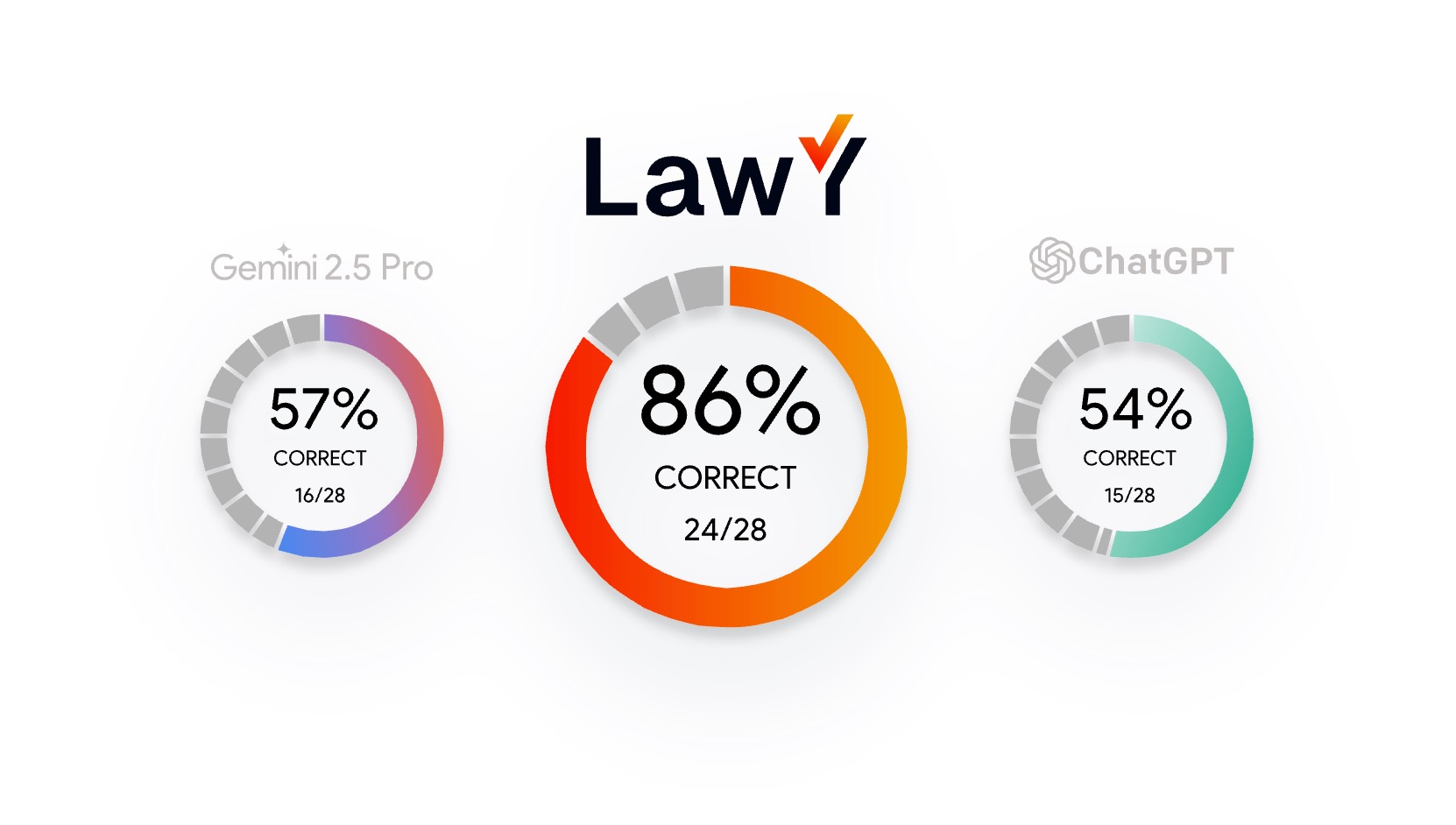 LawY - Best AI legal research assistant (see the proof of LawY's accuracy here)
3. LEAP Generator - Best AI document drafting tool for UK solicitors
⭐⭐⭐⭐⭐ (5/5 stars)
LEAP Generator addresses UK solicitors' most time-consuming task: legal document production. With 84% of UK solicitors reporting they save up to 6 hours weekly on drafting using AI, automated document creation represents the highest-impact AI application for British legal practice.
Overview: AI document production for UK legal practice
Document drafting consumes extraordinary solicitor time. A commercial lease might require 8-12 hours to draft properly. A complex will with trusts takes 4-6 hours. Even routine conveyancing contracts demand 2-3 hours of careful attention.
LEAP Generator transforms this reality. The platform creates first drafts of letters, contracts, court forms, and legal documents in seconds, using either your firm's existing precedents or AI-generated content from scratch. UK solicitors retain complete control, reviewing and refining outputs, while the heavy lifting of initial drafting is shifted to AI.
For High Street practices competing on efficiency and fixed-fee pricing, this capability fundamentally changes the economics of legal service delivery.
Key features for UK document drafting
Multiple drafting modes for maximum flexibility
LEAP Generator provides three complementary approaches:
Adapt existing firm precedents: Pull up your firm's standard commercial lease, settlement agreement, or client advice letter - Generator automatically customises it with matter-specific details (party names, addresses, dates, financial terms) from your case file. This preserves your firm's preferred language whilst eliminating repetitive data entry.
UK legal forms library: Access 6,000+ automated legal forms specifically for English, Welsh, and Scottish law - covering conveyancing (SDLT returns, TR1 transfers, lease agreements), litigation (N1 claim forms, witness statements, court bundles), family law (financial remedy applications, divorce petitions), corporate (shareholders agreements, board minutes), and employment (contracts, settlement agreements). Forms automatically populate with matter information and comply with current court rules.
AI generation from description: Simply describe the document needed - "draft a client advice letter explaining the litigation process for a County Court money claim" - and Generator creates a bespoke first draft. This works particularly well for client correspondence, advice letters, and non-standard documents.
Lightning-fast draft production for UK lawyers
Documents that traditionally require hours materialise in 30-90 seconds:
Commercial contracts: 45 seconds for initial draft
Court documents: 60 seconds, including party details
Client letters: 30 seconds with case-specific content
Wills and powers of attorney: 90 seconds with testator details
A conveyancing solicitor handling 15 completions monthly saves 30-45 hours simply on contract drafting - time redirected to client service or additional matter capacity.
Consistenly meeting UK legal standards
Generator uses your firm's approved templates and the UK's authoritative legal forms, ensuring:
Consistent clause structure and language
Standard definitions your firm prefers
Required provisions under English and Welsh law
Appropriate Scottish law variations when needed
Compliance with court practice directions
Up-to-date statutory references
This eliminates the risk of missing standard clauses or using outdated precedents - a common source of professional negligence claims for UK solicitors.
Intelligent editing and solicitor oversight
AI-generated drafts serve as starting points, not finished products. LEAP Generator:
Highlights areas requiring solicitor input (specific dates, amounts, client preferences)
Flags sections needing verification
Allows unlimited editing and refinement
Maintains version control for audit purposes
Integrates with Matter files for automatic detail population
UK solicitors maintain complete professional control whilst benefiting from the efficiency of AI-assisted drafting.
Integration within UK practice management systems
Generator operates as part of the unified LEAP platform, meaning:
Documents automatically save to the correct matter file
Client and matter details populate without re-entry
Output formats match your firm's house style
Integration with Microsoft Word for familiar editing
Automatic time recording for billing purposes
Version history for compliance documentation
This seamless integration eliminates the workflow disruption and data re-entry that plague standalone document automation tools.
Best for: UK solicitors across all practice areas needing fast, accurate document production that integrates with their existing systems whilst maintaining professional standards and SRA compliance.
Pricing: Included with LEAP subscription - comprehensive document automation without per-document fees or template library charges. [Contact LEAP for pricing details]
Results: UK solicitors report 84% save 2-6 hours weekly on document drafting, with firms handling 15-20% additional matter capacity using the same staff complement.
4. ChatGPT - Limited utility for UK solicitors
⭐⭐ (2/5 stars)
ChatGPT represents the consumer face of generative AI - widely accessible, remarkably capable for general tasks, but fundamentally unsuited for professional UK legal work without extensive manual oversight.
What ChatGPT can (and cannot) do for UK solicitors
Appropriate auxiliary uses:
Brainstorming legal arguments or strategy approaches
Drafting internal memoranda and training materials
Creating marketing content and blog posts
Generating meeting agendas or summaries
Initial research on unfamiliar topics (with verification)
Inappropriate for professional UK legal work:
Client advice or legal opinions
Legal research without verification (hallucination risk)
Document drafting for client delivery
Court submissions or formal correspondence
Anything involving confidential client information
Why ChatGPT creates compliance risks for UK solicitors
Lacks UK legal knowledge: ChatGPT lacks localised legal knowledge, frequently defaulting to American legal terminology and concepts. It might reference "attorneys," "discovery," "motion practice," and US statutory citations - completely inappropriate for UK solicitors' professional work.
No verification mechanism: ChatGPT provides no verification by qualified legal professionals. When it generates fabricated case citations (and it does), there's no safeguard preventing UK solicitors from unknowingly submitting false authorities to tribunals - as documented in 18 UK cases resulting in sanctions.
External data handling: The SRA's guidance emphasises that solicitors must understand where data goes and how it's processed. ChatGPT's external architecture makes SRA compliance problematic - LEAP's integrated approach eliminates these concerns.
No integration: ChatGPT operates entirely separately from practice management systems, requiring manual copying of outputs, separate verification workflows, and additional data handling - creating inefficiency and confidentiality risks.
Cost structure: Whilst ChatGPT Plus costs £15-20 monthly, the hidden costs emerge through inefficiency, lack of integration, verification overhead, and compliance risks. The apparent savings disappear quickly.
Limitations: No UK legal templates or forms, no integration with case management, no jurisdiction-specific knowledge, requires separate practice management software, additional subscription costs, generic business focus rather than legal specialisation.
Best for: Initial brainstorming, general research starting points, and non-client-facing content creation only. Never use for professional legal advice, research, or documents delivered to clients.
5. Microsoft Copilot - Marginal value for UK legal practice
⭐⭐⭐ (3/5 stars)
Microsoft Copilot brings AI capabilities to familiar Office 365 applications, offering productivity enhancements for general business tasks but providing limited value specific to UK legal practice.
What Microsoft Copilot offers UK law firms
General productivity features:
Email drafting and summarisation in Outlook
Document formatting and editing in Word
Data analysis and visualisation in Excel
Presentation creation in PowerPoint
Meeting transcription and summary in Teams
Why it underdelivers for UK solicitors:
No legal specialisation: Copilot provides general business AI, not legal-specific capabilities. It doesn't understand UK legal terminology, court procedures, statutory interpretation, or professional obligations.
No UK legal templates: Unlike LEAP Generator's 6,000+ UK legal forms, Copilot offers generic business document templates with no jurisdiction-specific legal content.
No verification mechanism: Like ChatGPT, Copilot provides no human verification by qualified solicitors - creating the same hallucination and accuracy risks documented in UK tribunal cases.
Limited integration: Whilst Copilot works within Microsoft 365, it doesn't integrate with practice management systems, case files, or legal accounting software - requiring manual data transfer and creating efficiency losses.
Additional licensing costs: Microsoft Copilot requires per-user licensing (approximately £24-28 monthly) on top of existing Office 365 subscriptions, adding £2,880-3,360 annually for 10-person firms without providing legal-specific capabilities that justify the investment.
The integration advantage LEAP provides
For UK firms already invested in Microsoft 365, LEAP provides seamless integration with Word, Outlook, and Excel while adding the legal-specific AI capabilities Copilot cannot provide. This combination delivers:
Copilot for general productivity tasks
LEAP AI for professional legal work
Integration between both environments
No additional Microsoft licensing requirements beyond baseline Office 365
This integration means solicitors work in familiar Microsoft interfaces whilst benefiting from LEAP's legal specialisation and AI capabilities.
Limitations: No UK legal templates or forms, no integration with case management, no jurisdiction-specific knowledge, requires separate practice management software, additional subscription costs, generic business focus rather than legal specialisation.
Best for: General office productivity tasks (email, presentations, spreadsheets) but not legal-specific work requiring UK jurisdiction knowledge, verification, or integration with case management systems.
How to choose the right AI tools for your UK practice
The optimal AI strategy depends on your firm's size, practice areas, technology infrastructure, and strategic priorities. Here's how to evaluate your options systematically.
Consider your firm's size and structure
Solo practitioners and small firms (1-5 solicitors)
Integrated solutions prove essential for smaller practices lacking IT resources:
Prioritise all-in-one platforms (LEAP) over piecemeal tools
Seek inclusive pricing without per-use charges
Ensure minimal technical complexity
Focus on UK-specific features over general AI
Demand human verification for professional peace of mind
SRA research reveals small firms face unique barriers:
52% struggle identifying suitable technology
72% worry about tools becoming outdated
Only 21% approached by providers directly
Overwhelmed by options or finding nothing suitable
Lack of time, technical knowledge, or confidence
LEAP addresses these concerns through integrated design, ongoing updates, proactive support, and a purpose-built UK legal focus.
Mid-sized firms (6-20 solicitors)
LEAP remains the optimal choice for core legal AI needs, providing the specialisation, integration, and compliance that UK practices require. Firms with existing Microsoft 365 investments might add Copilot for general office productivity - but this supplements rather than replaces legal-specific AI.
Mid-sized practices should prioritise:
Comprehensive AI covering all practice areas
Integration with existing practice management
Scalable solutions growing with the firm
Compliance features satisfying SRA obligations
Training resources for varied skill levels
UK jurisdiction expertise across all tools
Large firms (20+ solicitors)
LEAP for core legal AI supplemented by strategic additions - Microsoft 365 with Copilot for general productivity (if Microsoft ecosystem already in place), specialised research databases for complex matters, client portal and e-signature tools for client experience.
Larger UK firms typically supplement LEAP with specialised tools for specific practice areas (e.g., due diligence AI for corporate transactions, litigation analytics for complex commercial disputes) - but LEAP's core AI suite handles 80-90% of daily requirements.
Large firms should implement:
Enterprise-wide AI standards and governance
Centralised compliance monitoring and audit capabilities
Custom workflows for specialised practice groups
Advanced training programmes for all staff levels
Integration with a sophisticated legal tech stack
Consider your practice area focus
Residential conveyancing practices
UK residential conveyancing faces intense commoditisation pressures from online providers and alternative business structures. Traditional High Street practices compete primarily on service quality and speed - both enhanced by LEAP's AI.
Key AI applications:
Generator for SDLT returns, TR1 transfers, and lease agreements
Matter AI for tracking completion timelines and outstanding requisitions
LawY for resolving unusual title issues or leasehold complications
AutoTime for accurate time recording across multiple concurrent completions
Results: Leading conveyancing practices report 30-40% efficiency improvements, handling 15-20 additional completions monthly with existing staff, improved client satisfaction through faster updates, and reduced stress during completion day coordination.
Commercial litigation firms
Commercial litigation demands exhaustive document analysis, precise chronology preparation, and meticulous research into complex legal issues - all areas where LEAP AI excels.
Key AI applications:
Matter AI for analysing disclosure documents and identifying relevant evidence
LawY for researching procedural rules and case law authorities
Generator for drafting witness statements, particulars of claim, defences
Chronology generation for court bundle preparation
Results: Litigation boutiques report reducing disclosure review time by 60-70%, accelerating court bundle preparation from days to hours, improving research accuracy with verified citations, and maintaining competitiveness against larger firms.
Family law practices
Family law combines emotionally challenging client work with extensive form completion, financial disclosure analysis, and procedural compliance - creating unique efficiency opportunities for AI.
Key AI applications:
Matter AI for tracking detailed client instructions and family history
Generator for Form E preparation and financial remedy applications
LawY for maintenance calculations and pension sharing guidance
Document assembly for child arrangements applications
Results: Family law practices report a 60-70% reduction in Form E preparation time, improved legal aid matter profitability, faster client communication, and better work-life balance for solicitors.
General practices
High Street practices handling diverse matter types - residential conveyancing, probate, lasting powers of attorney, employment advice, commercial contracts, landlord-tenant disputes - benefit from LEAP AI's versatility across practice areas.
Key AI applications:
Matter AI for cross-practice context retrieval
Generator for diverse document types across practice areas
LawY for verified research spanning multiple specialisms
Integrated workflow across all matter types
Results: General practices report handling more diverse matters confidently, maintaining profitability across practice areas, reducing specialist referrals for routine matters, and improving client service through faster turnaround.
Overcoming barriers to AI adoption for small UK firms
SRA research reveals that whilst 82% of small UK firms agree technology helps provide better value, 96% identify barriers to adoption. Understanding and addressing these barriers proves essential for successful implementation.
Common barriers and practical solutions
Barrier 1: Difficulty identifying the right technology (52% of small firms)
Many solicitors feel overwhelmed by options or find nothing suitable for their specific needs. The market presents a "wild west" of choices, with conflicting claims and limited guidance.
Solution: Focus on integrated platforms specifically designed for UK legal practice. LEAP provides a comprehensive solution eliminating the need to research, select, and integrate multiple tools. The SRA endorses this approach, recommending solicitors seek:
Case studies from similar firms
Peer networking and knowledge-sharing
Independent guidance on technology choices
Clear information on SRA compliance
Barrier 2: Concern about outdated technology (72% of small firms)
Investing in technology that becomes outdated or non-compliant represents a significant worry for resource-constrained practices.
Solution: Choose cloud-based solutions with continuous updates included in subscription pricing. LEAP automatically updates with:
Latest UK legal forms and templates
New SRA compliance requirements
Enhanced AI capabilities
Security improvements
Legislative changes
This eliminates the "will it be outdated tomorrow" concern through ongoing evolution.
Barrier 3: Cost and unclear pricing (20% seeking transparency)
Small firms need predictable costs without hidden per-use fees that make budgeting impossible.
Solution: Select tools with transparent, inclusive pricing covering all AI features. LEAP includes Matter AI, LawY, and Generator without incremental charges - providing budget certainty. [Contact LEAP for pricing details]
Barrier 4: Lack of time, technical knowledge, or confidence
Small firm solicitors lack dedicated IT resources and feel uncertain about selecting and implementing technology.
Solution: Prioritise tools designed for solicitors, not IT specialists. LEAP's AI features require:
No technical knowledge - natural language queries only
Minimal learning curve - works within a familiar interface
Built-in training resources - UK legal examples
Point-and-click operation - no coding or configuration
For existing LEAP users, AI features activate immediately. New implementations are usually complete within 1-2 weeks.
Barrier 5: Supporting vulnerable or hard-to-reach clients (49% of consumer-facing firms)
Firms serving individual consumers, particularly vulnerable clients, find supporting them with technology challenging.
Solution: Integrated platforms like LEAP provide client portals, automated updates, and communication tools that help rather than hinder client service - even for less tech-savvy clients. Features include:
Plain-English client communications
Automated progress updates
Mobile-friendly access
Telephone support as backup
Solicitor availability for assistance
The verdict: Purpose-built legal AI versus general AI tools for UK solicitors
Our comprehensive analysis reveals a clear conclusion: whilst general AI tools like ChatGPT and Microsoft Copilot serve auxiliary purposes, they cannot match purpose-built legal AI for professional UK practice.
LEAP's integrated suite - comprising Matter AI, LawY, and Generator - provides the complete AI solution UK solicitors require to transform their practice whilst maintaining SRA compliance and professional standards.
Why specialised legal AI proves essential
UK jurisdiction expertise matters: English and Welsh law differ fundamentally from American law (where most general AI trains). Scottish law differs from English law. Court procedures, statutory interpretation, legal terminology, and professional obligations vary across jurisdictions. Purpose-built legal AI understands these nuances - general AI doesn't.
Human verification satisfies professional obligations: The SRA explicitly warns solicitors must not "trust AI to judge its own accuracy." LawY's qualified solicitor verification provides documented professional oversight. ChatGPT offers no verification mechanism. For UK solicitors facing tribunal scrutiny and indemnity insurance requirements, this difference determines professional viability.
Hallucination protection prevents sanctions: With 18 documented UK cases of AI-generated fabricated citations leading to sanctions, verification isn't optional - it's essential. LEAP's human verification by qualified solicitors eliminates hallucination risk. General AI tools create it.
Integration eliminates compliance risks and efficiency losses: Client data exported to external AI platforms creates confidentiality breaches and GDPR violations. LEAP's integrated AI operates within your secure practice management system - client information never leaves your protected environment. This architecture satisfies SRA obligations by design rather than requiring complex workarounds.
Inclusive pricing provides better economics: Most legal AI tools charge incremental fees - per query, per user, per feature tier. LEAP includes comprehensive AI capabilities at no additional cost. [Contact LEAP for pricing details] For UK firms operating on tight margins (44% facing client fee pressure), avoiding per-use charges proves critical for sustainable adoption.
The combination of UK legal expertise, human verification, seamless integration, and inclusive pricing makes LEAP the clear choice for firms serious about leveraging AI effectively and safely.
General AI's limited role in UK legal practice
ChatGPT and Microsoft Copilot aren't worthless - they serve specific auxiliary purposes:
Conceptual brainstorming: Exploring different approaches to legal arguments or client advice (not relying on factual accuracy)
General business writing: Internal memoranda, training materials, marketing content (not legal documents or client advice)
Office productivity: Meeting summaries, email drafting, spreadsheet analysis (not legal research or document production)
The risks of inaccurate legal information, confidentiality breaches from external data handling, and a lack of verification mechanisms far outweigh any perceived cost savings for professional legal work.
Transform your UK law practice with purpose-built legal AI
UK legal practice stands at an inflexion point. With 61% of UK lawyers now using AI in their daily work and adoption accelerating rapidly, technology competence has shifted from "nice to have" to "competitive necessity." Clients expect faster service, transparent pricing, and modern communication. The SRA requires competent, efficient practice whilst maintaining professional standards. Cost pressures demand improved profitability whilst competitive forces constrain fee increases.
Legal AI addresses all these pressures simultaneously - but only if implemented correctly.
The evidence overwhelmingly supports a clear conclusion: LEAP's integrated AI suite delivers the specialised capabilities, regulatory compliance, security protections, and economic value UK solicitors require. With Matter AI for case intelligence, LawY for verified research, and Generator for automated drafting - all included within a comprehensive practice management platform - LEAP provides the complete legal AI solution for British solicitors.
The opportunity cost of delay
Talent retention risk: 18-26% of solicitors would consider leaving firms failing to invest adequately in AI. Can you afford to lose your best people to more progressive competitors?
Career development imperative: 39-49% of solicitors believe failing to engage with AI would harm their careers. Are you giving your team the tools they need to succeed?
Competitive disadvantage: While 61% of UK lawyers now use AI daily, those without legal-specific tools risk efficiency, accuracy, and compliance problems. The adoption window is closing.
Client expectation gap: 60% of legal professionals report that clients now expect technology use. Are you meeting or falling behind client expectations?
Transform your practice with AI designed for UK solicitors
See LEAP's AI capabilities in action for your specific practice areas. Schedule a personalised demonstration showing exactly how Matter AI, LawY, and Generator integrate with your workflows, address your SRA compliance concerns, and deliver measurable time savings from day one.
Don't let competitors gain an insurmountable advantage. Whilst other firms struggle with general AI tools creating compliance headaches and security concerns, you could be capturing additional billable hours daily with AI purpose-built for UK legal practice.
Frequently asked questions about legal AI for UK solicitors
What is the best legal AI tool for small UK law firms?
For small UK law firms (1-5 solicitors), LEAP's integrated AI suite offers the optimal combination of features, value, and local relevance. With Matter AI for case intelligence, LawY for verified legal research, and Generator for document automation, small firms access enterprise-level AI capabilities addressing the barriers SRA research identified: difficulty selecting technology, concerns about tools becoming outdated, lack of technical expertise, and need for predictable costs. The UK law focus ensures compliance with SRA Standards and Regulations while the human verification features reduce professional risk exposure for firms without dedicated compliance officers.
How much do legal AI tools cost for UK solicitors?
LEAP includes all AI features within its standard subscription, making it a cost-effective, comprehensive solution for UK practices. [Contact LEAP for pricing details] General AI tools like ChatGPT have lower entry costs (£15-20 monthly for Plus subscriptions) but lack legal specialisation, integration with practice management systems, and verification mechanisms - creating hidden costs through inefficiency and compliance risks. Microsoft Copilot requires per-user licensing (approximately £24-28 monthly) on top of existing Office 365 subscriptions, adding £2,880-3,360 annually for 10-person firms without providing legal-specific capabilities.
Can AI replace solicitors in the UK?
No, AI cannot and will not replace UK solicitors. AI tools assist with routine tasks - research, document drafting, information retrieval - but cannot replicate professional judgment, client relationships, advocacy skills, or strategic legal advice. The SRA's regulatory framework explicitly requires qualified solicitors to remain responsible and accountable for all work, including AI-assisted outputs. Legal judgment, ethical decision-making, negotiation, court advocacy, and client counselling remain firmly in the human domain, requiring years of training and experience. Research shows clients increasingly expect advice that cannot be easily gleaned from readily available AI-powered search tools, highlighting the enduring value of solicitor expertise.
What's the difference between legal AI and general AI tools for UK solicitors?
Legal AI tools like LEAP's suite are specifically trained on legal information and designed for law firm workflows. They understand UK legal terminology (claimant not plaintiff, Crown Court not criminal court), cite cases correctly using neutral citations and law reports, include jurisdiction-specific templates (English, Welsh, Scottish law variations), and integrate with case management systems. Most critically, legal AI like LawY includes human verification by qualified UK solicitors - addressing the hallucination risk that has led to sanctions in 18 documented UK cases. General AI tools like ChatGPT lack legal specialisation and may produce plausible-sounding but legally incorrect information - creating significant professional risk. For professional use requiring accuracy, compliance, and accountability, legal-specific AI proves essential.
How long does it take to implement legal AI in a UK law firm?
LEAP's integrated AI can be operational immediately for existing LEAP users since Matter AI, LawY, and Generator activate within the platform that solicitors already use daily. New firms implementing LEAP typically complete setup within 1-2 weeks. General AI tools like ChatGPT access immediately but require careful oversight protocols, staff training on limitations and risks, development of verification workflows, and ongoing monitoring - creating ongoing implementation costs. The key difference: LEAP's AI integrates with existing workflows while external tools require process changes and compliance workarounds.
Is legal AI secure for handling UK client data?
Security depends entirely on the specific tool and implementation approach. LEAP's AI keeps all data within your secure practice management system, ensuring UK GDPR compliance, maintaining client confidentiality under SRA obligations, providing audit trails for compliance verification, using ISO 27001 certified security controls, and keeping data in UK-based systems. General AI tools like ChatGPT operate outside your secure environment, potentially exposing client information to external systems, using inputs for model training (creating confidentiality risks), providing no audit trail for SRA compliance, and transferring data internationally. Never input confidential client information into public AI tools. For professional use, choose legal AI operating within your protected environment.
Do I need technical expertise to use legal AI tools?
Modern legal AI tools are designed for solicitors, not IT specialists. LEAP's AI features work within the familiar practice management interface solicitors use daily with no technical knowledge required - natural language queries (just ask questions normally), automatic system responses (no coding or configuration), built-in training resources (UK legal examples), and point-and-click document generation. General tools like ChatGPT and Microsoft Copilot use simple interfaces but require more manual work to integrate outputs into legal workflows, verify accuracy before professional use, and develop compliance protocols. Technical expertise isn't required, but legal-specific AI significantly reduces the learning curve and compliance complexity.
Which legal AI tool is best for document drafting in UK practice?
LEAP Generator provides the most comprehensive document drafting solution for UK solicitors, featuring automatic integration of matter data from case files, 6,000+ UK-specific legal forms and templates (covering conveyancing, litigation, family, probate, and employment), compliance with court practice directions and formatting requirements, integration with firm precedent libraries, and support for English, Welsh, and Scottish law variations. Whilst ChatGPT can help with initial drafts and Microsoft Copilot enhances Word document creation, neither matches LEAP's legal specialisation, automated data population, or workflow integration. For professional UK legal document production, purpose-built tools deliver superior results with less manual intervention.
Can legal AI help with UK court forms and procedures?
Yes, but capabilities vary dramatically between general and specialised AI. LEAP Generator includes UK court forms for County Court proceedings (N1 claims, N244 applications, N9 defences), High Court proceedings (claim forms, witness statements, skeleton arguments), Family Court applications (financial remedy, child arrangements), and Scottish Sheriff Court forms - automatically formatted to meet current court rules and practice directions. The system understands procedural requirements (correct font sizes, paragraph numbering, prescribed wording) and populates forms with party details from matter files. General AI tools like ChatGPT and Copilot lack this localised knowledge and cannot ensure compliance with UK court formatting requirements. For court document production, legal-specific AI proves essential.
What are AI hallucinations, and how can I prevent them?
AI hallucinations occur when generative AI produces plausible but entirely fabricated information - particularly legal case citations. With 18 documented UK cases resulting in sanctions (including monetary penalties, disqualification, and disciplinary referrals), hallucinations represent a serious professional liability risk. Prevention requires:Using legal-specific AI with human verification (like LawY)
Never relying solely on general AI for legal research
Verifying all case citations before including them in submissions
Maintaining audit trails showing professional oversight
Following SRA guidance on AI supervision
LEAP's integrated approach with qualified solicitor verification eliminates hallucination risk, whilst general AI tools like ChatGPT create it. For UK solicitors, this distinction determines whether AI enhances or endangers professional practice.
How do I get started with legal AI in my UK law firm?
Start by identifying your firm's specific needs - document drafting bottlenecks, legal research overhead, or case management inefficiency.
For comprehensive AI assistance across all areas, request a LEAP demonstration to see all integrated features working together in real UK legal scenarios. The demonstration shows exactly how Matter AI answers questions from your case files, how LawY provides verified research on actual legal questions, and how Generator produces documents using UK legal forms.
You can experiment with free tools like ChatGPT for general brainstorming, but remember that these aren't suitable for professional legal work without significant oversight and verification. This makes purpose-built legal AI the practical choice for UK solicitors serving clients professionally.
Transform your UK legal practice with AI built for solicitors.
Schedule a personalised LEAP demonstration today to see how Matter AI, LawY, and Generator can deliver measurable time savings and improved client service whilst maintaining SRA compliance and professional standards.
Your competitors are already capturing additional billable hours daily. Don't fall behind.
Related Articles
:quality(82))
Over 60% of UK lawyers now use AI. Learn how legal-specific AI platforms like LawY and LEAP are driving accuracy, safety, and strategic adoption.
:quality(82))
In an era where legal professionals face growing pressure to deliver faster, more accurate results whilst managing increasingly complex workloads, forward-thinking lawfirms are finding ways to work more intelligently. One firm is Hertfordshire-based Wason Male & Wagland, which has embraced artificial intelligence to transform its operations and deliver improved outcomes for clients.
:quality(82))
The legal industry is undergoing a huge shift, driven by advancements in artificial intelligence (AI). While much of the focus has been on AI’s ability to enhance operational efficiency, its impact on billing practices and client relationships is equally transformative. In a sector long dominated by traditional hourly billing, AI offers a path to new, outcome-based pricing models that benefit both law firms and clients.
:quality(82))
The legal industry has traditionally been resistant to change, but the emergence of artificial intelligence (AI) presents an undeniable opportunity to enhance efficiency and profitability for law firms.
Transform Your Irish Law Practice with AI Built for Solicitors
Stop wasting time with generic AI tools. LEAP’s integrated suite—Matter AI, LawY, and Generator—is designed specifically for Irish solicitors, delivering verified accuracy, seamless integration, and proven time savings of 2+ hours