Criminal Law
Case Notes: Plain-English summaries of NSW criminal decisions

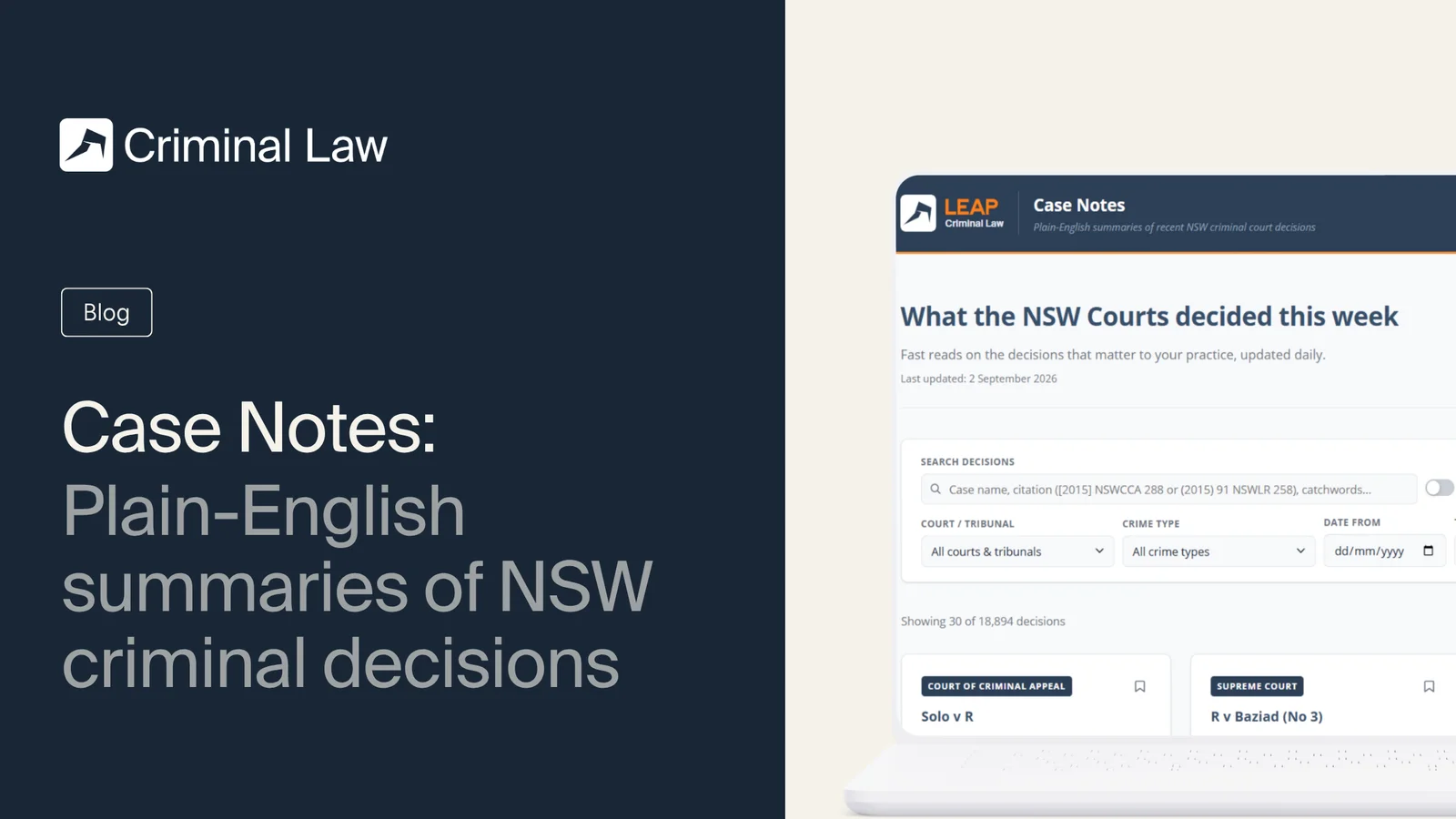
Every NSW criminal decision, in plain English, within hours of publication
Staying current with NSW Caselaw is a task that never really stops. The decisions land without pronouncement, the useful ones look identical to the routine ones in a results list, and by the time you are appearing on a case with an unusual set of facts, the case that would have helped is two years old and buried.
So we built Case Notes.
Case Notes is a free, public record of NSW criminal decisions. Every decision is summarised in plain English, tagged by court and offence type, and linked back to the full judgment on NSW Caselaw. It updates twice a day, so a decision published this morning is usually summarised by this afternoon.
There is no login, no trial, and no charge. It is open to anyone practising criminal law in NSW.
Disclaimer: The case summaries on this blog are analyses of caselaw created by AI. AI does not provide legal advice and can make mistakes. Consider checking important information.
Which NSW courts and decisions are covered
More than 18,800 decisions, covering:
Court of Criminal Appeal: 9,400+ decisions
District Court: 5,500+ decisions
Supreme Court: 3,600+ decisions
Local Court: 200+ decisions
The archive runs back through the historical record, so it works as a research tool as well as a way of keeping up to date.
What you can actually do with Case Notes
Search the way you think about a case. Alongside ordinary keyword search, Case Notes has Advanced Search, where you can paste in a plain-text description of your case. Ask it about intensive correction orders for mid-range drug supply and you get decisions on that point, ranked by how closely they match, not by how many times a phrase appears. Each result explains why it matched.
Spot the authorities that matter. Cases that later decisions rely on heavily are marked as key authorities. A frequently cited authority can rank above a closer topical match in your results.
Filter to what you are looking for. Narrow by court, date range, and offence type: sexual offences, assault and violence, homicide, drugs, fraud and dishonesty, theft and property, traffic and driving, firearms, domestic and family violence, and public order offences.
See how a case has been treated. Each summary shows which later decisions in Case Notes cite it, so you can follow an authority forward rather than reading it in isolation.
Save what is relevant and take it with you. Bookmark decisions as you read, then export the lot to PDF or Word for a brief, a file note, or a conference with counsel.
Read the latest NSW criminal decisions on Case Notes
Get it delivered. Subscribe by email or by RSS to everything, to a single court, or to one offence type. Point your reader at the Court of Criminal Appeal feed and every new CCA decision arrives with a summary attached. Receive weekly email digests summarising the court or case types you are interested in.
If you have questions or feedback, or you spot an issue with a summary, let us through the feedback form or email us leap.criminal@leap.com.au.
Case Notes is built by the LEAP Criminal Law team, who also look after LEAP's practice management software for criminal law firms.
Frequently asked questions
Are Case Notes summaries written by AI?
Yes. Every summary is generated by AI and is a reading aid, not legal advice. Each one links to the full judgment on NSW Caselaw so you can check it against the source.
Do I need to be a LEAP customer to use Case Notes?
No. Case Notes is free and public, with no login and no trial.
How often is Case Notes updated?
Case Notes is updated every day, so most new decisions are summarised within hours of appearing on NSW Caselaw.
How do I report an error or a suppression concern in a summary?
Use the feedback form on Case Notes, which covers factual errors, typos, and privacy or suppression concerns, or email leap.criminal@leap.com.au.
About the writer

Related Articles
The NSW Court of Criminal Appeal revoked the guideline judgement of R v Whyte read what they've replaced it with.
Enter one Law Part Code and LEAP fills in the section, Act and offence description from the Judicial Commission's database. Here's how the Criminal Charges table works, and how the AI fills it in from a Court Attendance Notice.
MRRC is now the 24-hour metropolitan intake hub and Parklea is back in public hands. Here's what changed across NSW correctional centres on 1 October 2026.

Recording a private conversation without consent is generally an offence. What the High Court held in Potter v The King about exceptions.
Keep up to date with LEAP Criminal Law
See the latest products created by the LEAP Criminal Law team.