Personal Injury
NSW psychological injury reforms: What changed on 1 July 2026
:quality(70))
:quality(85))
If you act for workers with a psychological injury, the rules you relied on before 1 July no longer apply. On that date the biggest shake-up to workers compensation claims in over a decade took effect in New South Wales.
Here’s what’s changed for these claims:
A new gateway. Every claim must now clear it.
A reworked reasonable management action defence.
A 130-week cap on weekly payments.
A higher damages threshold of 25% whole person impairment.
A new role for the Industrial Relations Commission.
Read together, the changes point one way: far fewer psychological injury claims will make it into the scheme at all.
Relevant documents:
Disclaimer: The information provided in the articles in this section are of a general nature and should not be construed as specific advice or relied upon in lieu of appropriate professional advice. Whilst LEAP Legal Software uses commercially reasonably efforts to ensure the information in these articles are up to date at the time of publication, LEAP does not warrant their accuracy, currency or completeness and excludes all loss or damage howsoever arising (including through negligence) in connection with the information contained in these articles.
Why the NSW Government acted: cost and a widening recovery gap
Two problems pushed the government to act, and both had been building for years.
The first was cost. Psychological injury claims had grown far more expensive than the scheme was built to absorb, and that pressure was starting to flow through to employer premiums. The second, was that workers with a psychological injury were not recovering or returning to work the way workers with a physical injury did.
The figures NSW Treasurer Daniel Mookhey put to Parliament in March 2025 made the case hard to argue with. From 2019-20 to 2024-25, physical injury claims rose by a modest 16%. Psychological injury claims, by comparison, doubled.
While psychological injury claims make up only around 12% of the workers compensation scheme, they account for close to 38% of its total cost. The recovery gap is just as stark: roughly 88% of workers with a physical injury are back at work within 13 weeks, yet around 40% of workers with a psychological injury are still out of work a full year later.
None of this means workplaces suddenly became twice as dangerous. Much of the rise reflects something healthier: a growing recognition that psychological injury is real and compensable, and a welcome fading of the stigma around speaking up. But the reason barely matters to the scheme’s bottom line. Psychological injuries are not physical injuries. They cost more, recovery follows no fixed timeline, and they keep people out of work far longer. Left unchecked, the trend pointed one way: towards a scheme carrying more than it was built to carry.
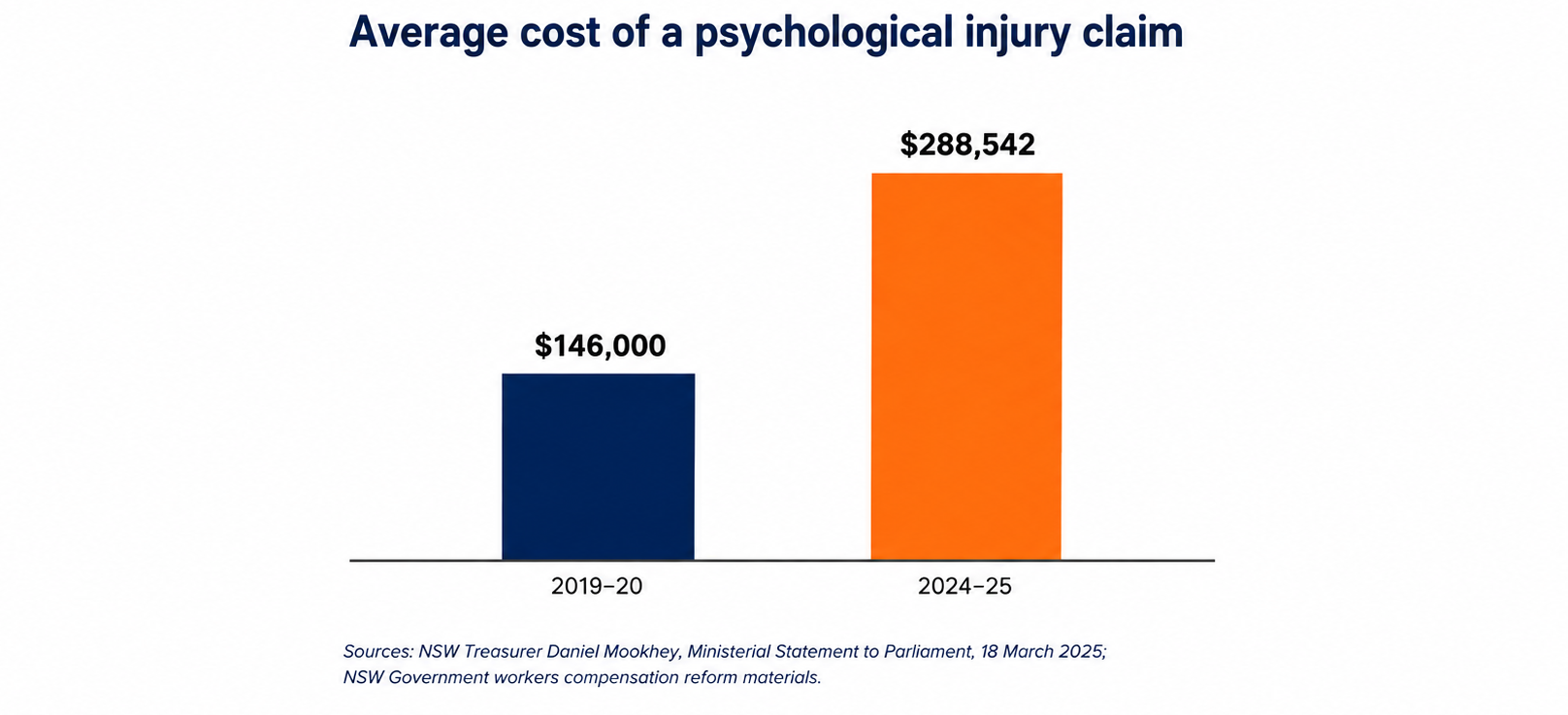
The reforms respond on two fronts. They tighten who can get into the scheme, and they invest heavily in prevention and return to work. A $344 million Workplace Mental Health package funds 50 new SafeWork inspectors, a return-to-work intensive program, $15 million in wraparound psychological services, a new Psychosocial Advisory Service, and a Chief Psychiatrist review of how psychological impairment is assessed.
Whether tightening eligibility does anything to solve the harder of the two problems, getting people well and back to work, is another question. It will be some time before anyone can answer it.
The new gateway: relevant events and the main contributing factor test
The single biggest change is how a claim gets in the door. Before 1 July, the entry point was much broader, and a wide range of work-related psychological injuries could form the basis of a claim. A worker still needed a diagnosed psychological injury, and employment had to be a substantial contributing factor (s 9A).
Now there is a new gateway, with a stricter lock. The injury must be caused by a defined ‘relevant event’ (s 8G):
violence;
criminal conduct;
witnessing trauma;
vicarious trauma;
events tied to bullying, sexual and racial harassment, and excessive work demands; and
another event prescribed by the regulations.
The causation bar is also higher: there must be a ‘real and direct’ connection to work, and employment must be the ‘main’ contributing factor (s 8O), up from ‘substantial’. A mere perception of bullying no longer clears the bar.
The reforms do not alter what competent practice has always required. Securing the diagnosis, identifying the event, and ensuring the Certificate of Capacity is properly completed were always priorities at the outset of a claim. What has changed is the ease with which liability can now be disputed. A narrower gateway and a higher causation threshold give insurers considerably more scope to decline liability than under the previous regime.
The nature of the injury may also determine the forum in which a dispute is resolved. Several of the defined events, particularly bullying and harassment, derive their meaning from employment and work health and safety legislation, and those definitions remain untested in the workers compensation context. For those events, a disputed claim may now fall to be determined by the Industrial Relations Commission, rather than resolved within the compensation system alone.
The reasonable management action defence: what s 11A now covers
Employers have long had a defence to psychological injury claims arising from reasonable management action. Under the previous law, s 11A of the Workers Compensation Act 1987 provided that no compensation was payable where the injury was wholly or predominantly caused by reasonable action taken in respect of matters such as transfer, demotion, performance appraisal, discipline, or dismissal.
The reforms alter this defence in two respects. First, the range of protected actions has been expanded. It now expressly covers performance feedback, workplace investigations, discipline, and stand-downs. Second, and more significantly, the causation standard has changed. Where the defence previously required the management action to be the whole or predominant cause of the injury, it now applies where reasonable management action was ‘the significant cause’.
The difficulty is that this formulation is untested, and everything turns on how ‘the significant cause’ is read.
Take a worker whose injury has two drivers at once: a disciplinary process and an excessive workload. On one reading, the employer must show that its disciplinary action was the primary cause of the injury before the defence succeeds, so if the workload did more of the damage, the defence fails. That is a demanding standard, and one that favours workers, because it is hard for an employer to establish. On another reading, the employer need only show that its disciplinary action was one significant cause among several, even if it was not the largest. That is far easier to prove, and favours employers. Until a court resolves the point, it is unclear how readily the defence can be made out.
The 130-week cap and the 25% WPI threshold
There are two distinct changes to be aware of here. Weekly payments will now generally cease at 130 weeks, unless the worker reaches 25% whole person impairment (WPI). Separately, the threshold to pursue work injury damages has risen from 15% to 25%.
Under 21% WPI: weekly payments stop at 130 weeks.
21% to under 25%: a further 52 weeks at 60% of wages (to week 182), plus the return-to-work intensive program.
25% and above: weekly payments continue past 130 weeks, and work injury damages open up.
Two points are worth keeping in mind. First, the s 66 lump sum threshold remains at 15%; it is the work injury damages threshold that has moved to 25%. Second, 25% WPI is an exceptionally difficult threshold to meet for a psychological injury, and very few claimants will reach it. For perspective, a worker assessed at Class 3 across every PIRS category (someone struggling to care for themselves, rarely leaving home, and unable to sustain normal employment) still reaches only around 22%. Reaching 25% will generally require a Class 5 rating (total impairment) in at least one category.
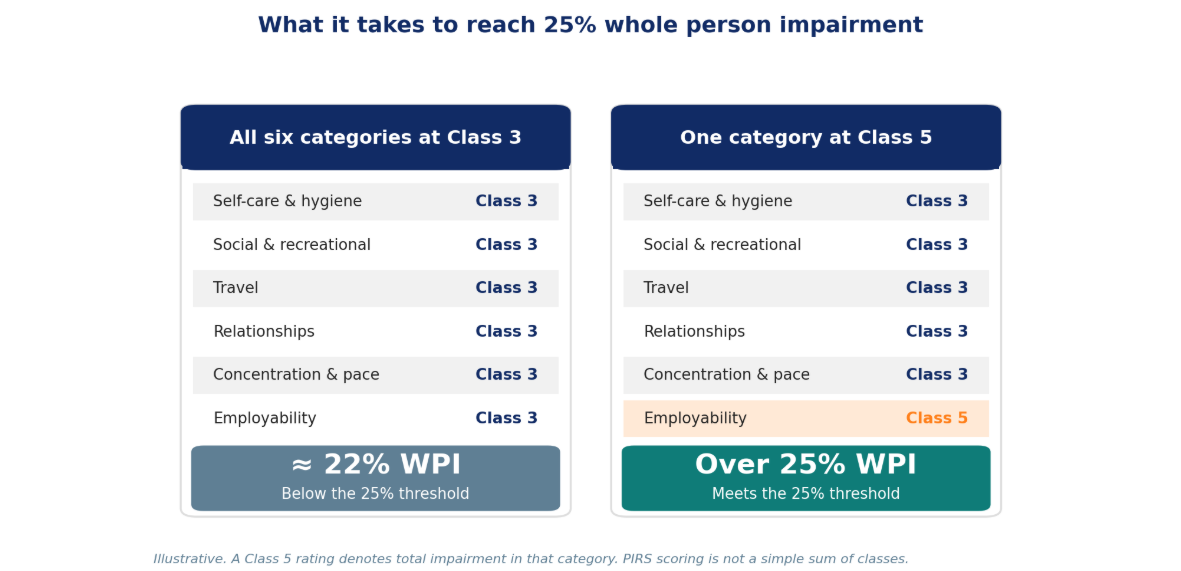
The real lesson is to plan early rather than react late. Lawyers will be required to have honest conversations about a realistic return to work, and about how a worker will fund their own treatment once scheme coverage tapers off.
Which regime applies?
These reforms only apply to claims notified on or after 1 July 2026. Notify before that date and the old rules still apply. However, that single date can now mean the difference between a valuable claim and no claim at all. Expect insurers and workers to argue hard over the notification date, particularly for gradually developing injuries where symptoms may have been reported at various times, and for aggravations of existing claims.
When a claim falls outside the gateway
If a claim can’t clear the gateway, the blunt answer is there are no workers compensation benefits available. However, before conceding, re-check the gateway:
Is it really not a relevant event?
Is there a physical injury that makes this a secondary psychological claim, which skips the gateway?
Is the worker exempt, given that police, paramedics, firefighters, coal miners, and volunteers are carved out of these reforms?
If none of those apply, the remaining options sit outside the scheme. On the compensation side, look closely at TPD and income protection through superannuation. We may well see an influx of psychological claims in superannuation. Centrelink support may also be available where the worker is eligible. There are also employment-law pathways, for example the IRC’s anti-bullying and sexual harassment jurisdiction.
One practical step to take from day one
The Certificate of Capacity warrants closer attention than ever. A strong certificate does two things: it identifies the specific diagnosed disorder (adjustment disorder, anxiety, depression, PTSD), and it connects that disorder to a relevant event. Those two elements are, in effect, the diagnosis and the causation on which the claim stands or falls. A certificate that records only ‘stress’, or that never links the injury to an event, hands an insurer an early reason to dispute liability. Make sure your client understands what a well-completed certificate contains, and the difficulties a vague one may create for them down the track.
Keeping your practice across the change
Reform like this lands on a practice in small, practical ways: the right form, the current version of it, and a matter file that can show exactly when a claim was notified.
Forms and precedents that keep pace. LEAP Legal Software updates its NSW workers compensation forms and precedents as the scheme changes, so you are not working from a pre-1 July version of a document.
A matter record that can evidence the notification date. With correspondence, file notes and documents held against the one matter, the evidence of when an injury was first notified is where you need it if an insurer disputes the date.
A way to test untested wording. Phrases like ‘the significant cause’ will be argued long before they are settled. LawY lets you put a research question to a qualified lawyer without leaving the matter.
Practical takeaways
Establish the notification date first. It decides which regime applies, and it will be contested.
Name the event, not the feeling. The claim has to attach to a defined relevant event with a real and direct connection to work.
Treat the Certificate of Capacity as day-one work. A specific diagnosis, and a clear line from that diagnosis to the event.
Check the gateway twice before conceding. Secondary psychological claims and exempt workers do not go through it.
Have the funding conversation early. For most psychological injury claims, weekly payments now stop at 130 weeks.
Watch LEAP’s webinar discussion
For a broader discussion of the 1 July 2026 reforms and their practical implications for psychological injury claims, watch LEAP’s webinar on the NSW workers compensation changes.
Frequently asked questions
Do the new NSW psychological injury rules apply to my client's claim?
Only if the injury was first notified on or after 1 July 2026. Claims notified before that date stay under the old rules, so establish the notification date first.
What counts as a relevant event for a psychological injury claim in NSW?
One of the defined categories: violence, criminal conduct, witnessing trauma, vicarious trauma, events tied to bullying, sexual and racial harassment and excessive work demands, or a further event prescribed by the regulations. An injury outside those categories does not clear the gateway.
Has the lump sum threshold for permanent impairment changed?
No. The s 66 threshold remains at 15% WPI. It is the work injury damages threshold that has moved from 15% to 25%.
What happens to weekly payments at 130 weeks?
They stop for most workers with a primary psychological injury. Between 21% and under 25% WPI, a further 52 weeks at 60% of wages; at 25% and above, payments continue.
Which workers are not caught by the reforms?
Exempt workers, coal miners and volunteers, and secondary psychological injuries arising from a physical injury skip the gateway. Confirm the exemption before treating a claim as outside the reforms.
About the writer
:quality(85))
Related Articles
:quality(82))
News from the LEAP Personal Injury team: Chronology, ALPMA and ALA presence, Case Note Blogs, and Released Prompts.
:quality(82))
Most psychological injury claims now stop well short of damages in NSW. Leggett shows why a Fair Work claim sits entirely outside the new caps.
:quality(82))
The 5% uplift under s 66(2A) stops at the lumbar spine. Why the neck misses out, and the trap in SIRA's benefits guide.
:quality(82))
The High Court has restored exemplary damages over the Don Dale CS gas incident. What [2026] HCA 20 means for your intentional torts practice.
Built for your practice. Built by people who get it.
See what LEAP looks like for your area of law.