Personal Injury
Back, not spine: Why the 5% uplift excludes the cervical spine
:quality(70))
:quality(85))
A practitioner who calculates a s 66 lump sum from the regulator's own benefits guide can arrive at the wrong figure. In New South Wales, back injuries are treated slightly more generously than other injuries. A worker with permanent impairment of the back receives 5% more compensation for that impairment than a worker impaired anywhere else in the body. There is an intuitive logic to that.
Relevant documents:
Workplace Injury Management and Workers Compensation Act 1998 (NSW) No 86
Workers Compensation Legislation Amendment (Miscellaneous Provisions) Act 2005 (NSW) No 113
Fletcher International Exports Pty Ltd v Barrow [2007] NSWCA 244; (2007) 5 DDCR 247
State Insurance Regulatory Authority (SIRA) NSW, Table 4.3: Pelvic Structures
Disclaimer: The information provided in the articles in this section are of a general nature and should not be construed as specific advice or relied upon in lieu of appropriate professional advice. Whilst LEAP Legal Software uses commercially reasonable efforts to ensure the information in these articles are up to date at the time of publication, LEAP does not warrant their accuracy, currency or completeness and excludes all loss or damage howsoever arising (including through negligence) in connection with the information contained in these articles.
Quick takeaways
s 66(2A) of the Workers Compensation Act 1987 (NSW) adds 5% to permanent impairment compensation for the back (injuries from 1 January 2006).
The Commission applies the uplift to the thoracic and lumbar spine only. A cervical (neck) component takes no uplift.
the State Insurance Regulatory Authority's (SIRA's) current benefits guide still refers to the ‘spine’, so a calculation made from the guide alone can overstate the entitlement.
In Australia back pain is the leading cause of non-fatal burden, ahead of every other condition, and the third leading cause of total disease burden behind only coronary heart disease and dementia. Nothing in the country causes more disability, which is precisely what permanent impairment compensation measures. If any single part of the body warrants a premium, the back has the strongest claim to one.
Section 66(2A) of the Workers Compensation Act 1987:
“To the extent to which the injury results in permanent impairment of the back, the amount of permanent impairment compensation calculated in accordance with subsection (2) is to be increased by 5%.”
This makes what follows harder to explain. The uplift applies to the thoracic and lumbar spine only, and excludes the cervical spine. Yet the spine is one continuous structure, running from the base of the skull to the coccyx, and the cervical spine is part of it. So why is the neck left out?
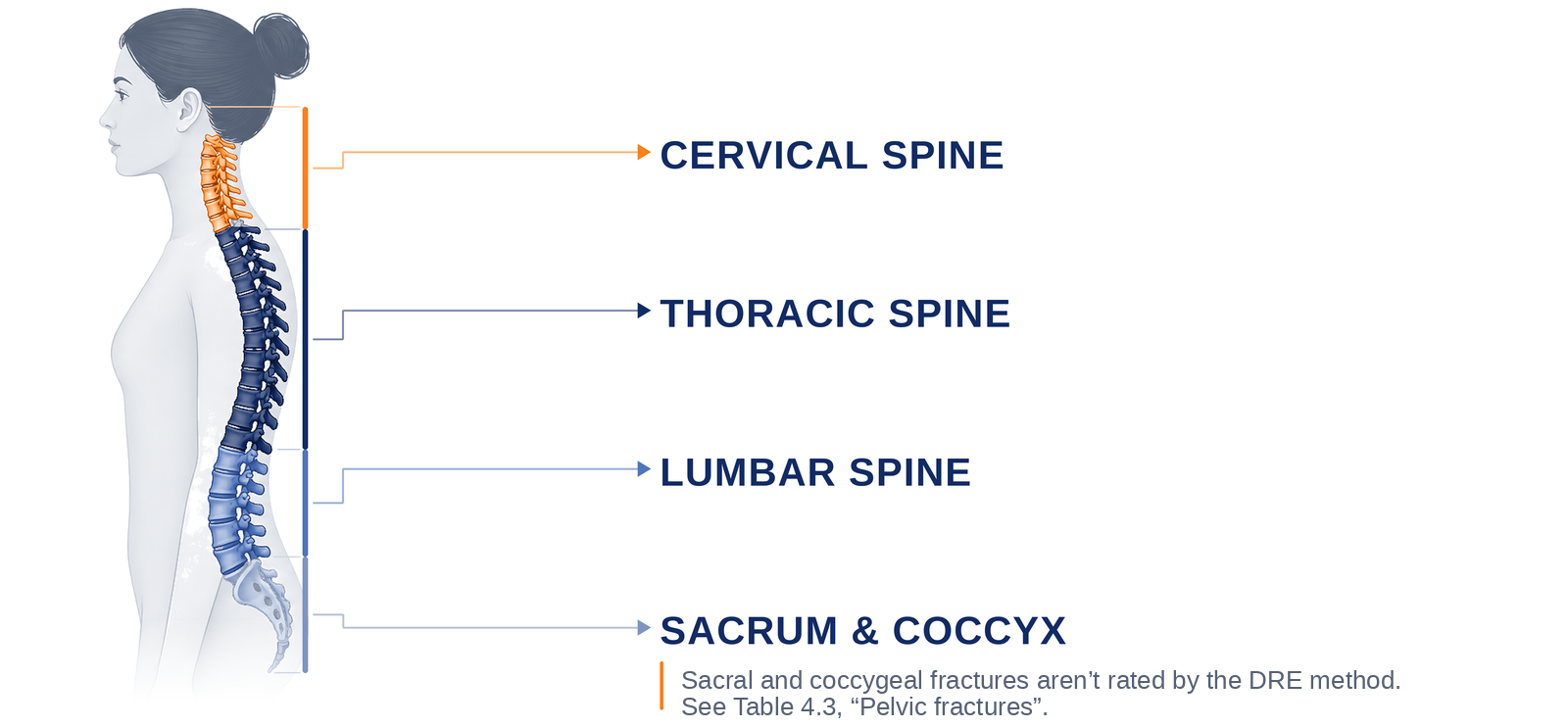
What is the definition of ‘back’?
The obvious starting point is the definition. However, neither the Workers Compensation Act 1987 nor the Workplace Injury Management and Workers Compensation Act 1998 offer one. The same goes for definitions of ‘spine’, ‘neck’ or ‘cervical spine’. The legislature inserted an everyday word, without defining it.
Medical sources do not clearly settle the debate either. This is largely because medical professionals barely use this overarching term.
What’s more, the assessment instrument does not help. Chapter 15 of the AMA Guides (5th ed), which SIRA guidelines adopt in Chapter 4, is titled “The Spine”. This guideline treats the cervical region exactly as it treats the lumbar and thoracic.
Salih v Versatile Ceramics: the uplift stops at the lumbar spine
The question was argued squarely in Salih v Versatile Ceramics. A storeman collapsed while mowing on a hot day and was assessed at 11% whole person impairment. The 11% figure comprised 6% lumbar and 5% cervical. Liability was not in issue. The only question was whether the uplift attached to all 11% or only the lumbar 6%.
Arbitrator Garth Brown held it attached to the lumbar component alone, and his reasoning was short. If Parliament had wanted the uplift to reach the neck, “it would have been a simple matter” to write ‘back and neck’ or ‘spine’. However, it did not (at [25]).
He was “fortified” in that view by the Commission’s e-bulletin No 33 of November 2009, issued over the name of President Keating, which he set out in full:
“It is the Commission’s practice that the 5 per cent uplift in compensation payable under section 66(2A) applies only to injuries to the lumbar and thoracic spine, thus excluding injuries to the cervical spine.
This position has been adopted by the Commission on the basis that section 66(2A) refers to the ‘back’ and not ‘the spine’ and there is a long line of prevailing case law that regards the cervical spine as part of the neck rather than the back.
Lump sum compensation awards issued by the Commission for the cervical spine will not include the uplift under section 66(2A).”
This means the cervical spine is not, for this purpose, the back. A narrow interpretation of the word is made, finding the ‘back’ as a region of the body that ends where the neck begins, rather than as a shorthand for the spine.
Why SIRA’s benefits guide doesn’t override s 66(2A)
In Salih, the Applicant’s real difficulty was that the regulator was saying the opposite. The Applicant tendered a WorkCover fax stating that “the 5% uplift for impairments of the spine apply to all areas of the spine, cervical spine (or neck) being one of those”, and pointed to the WorkCover Benefits Guide, whose notes referred throughout to the ‘spine’ and to ‘spinal injuries’ rather than the back.
That got him nowhere, and on orthodox principles it could not. Relying on Fletcher International Exports Pty Ltd v Barrow [2007] , where Mason P observed that “the word ‘guidelines’ is usually encountered with reference to a non-binding indication of policy”, the Arbitrator held (at [24]):
“I accept the WorkCover Benefits Guide April 2011 is a guideline. It does not override the plain language of the 1987 Act. It has been held that a guideline does not imply command or dictation.”
He traced that proposition to the High Court in Norbis v Norbis (1986) 161 CLR 513 and the Full Federal Court in Riddell and Smoker, which “have made it clear that the normal meaning of ‘guideline’ is guidance, and something that is not binding or mandatory in nature”.
Fifteen years on, the inconsistency has not been fixed. SIRA’s current benefits guide still carries notes that a 5% uplift is payable “where there is impairment of the spine”. Therefore, a practitioner calculating from the regulator’s own guide without reference to the authorised interpretation of section 66(2A), can still arrive at the wrong compensable amount.
The awkward fact nobody cites
One piece of material sits badly with all of this and does not appear to have been put to the arbitrator in Salih.
Section 66(2A) was inserted by the Workers Compensation Legislation Amendment (Miscellaneous Provisions) Act 2005. Introducing the Bill on 29 November 2005, the Minister described the amendment twice, the first time as “an increase in benefits payable to workers who suffer spinal injuries of 5 per cent in dollar terms”. The word ‘back’ does not appear in the speech at all. That is extrinsic material of the kind s 34 of the Interpretation Act 1987 permits a court to consider, and it points the other way. It is also, almost certainly, why the regulator’s guides have said ‘spine’ ever since.
Getting the s 66 calculation right in practice
The gap between the regulator’s guide and the authorised interpretation is exactly where a busy practice loses time. LEAP Legal Software’s regularly updated legal content and personal injury precedents reflect current practice, so a s 66 claim can be prepared from the authorised position rather than a guideline summary, with the calculation and supporting material kept on the matter for when a figure is questioned.
Where that leaves us
The position is settled by practice rather than authority. The uplift applies to the thoracic and lumbar spine only. Section 66(2A) remains in force for injuries received on or after 1 January 2006.
The larger point is about drafting. The uplift exists because back injury is the single most disabling condition in the country. The neck was excluded not by policy choice but by a word, one the Minister who introduced the amendment did not use, that the regulator has never adopted, and that the assessment instrument the scheme mandates does not recognise.
Parliament could fix it in a single sitting. Until it does, the neck is not considered to be the back, and the worker receives no additional compensation.
Practical takeaways
Apply the uplift to the thoracic and lumbar components only; exclude any cervical component from the 5% calculation.
Calculate from s 66(2A) and the Commission’s practice, not from the benefits guide’s ‘spine’ wording.
Confirm the injury was received on or after 1 January 2006 before applying the uplift.
Frequently asked questions
Does the 5% uplift under s 66(2A) apply to neck injuries?
No. The Commission’s practice is that the uplift applies to impairment of the thoracic and lumbar spine only. The cervical spine is treated as part of the neck rather than the back, so a cervical component takes no uplift.
What does s 66(2A) of the Workers Compensation Act 1987 (NSW) provide?
It provides that, to the extent an injury results in permanent impairment of the back, the permanent impairment compensation calculated under s 66(2) is increased by 5%.
When did the 5% back uplift commence?
It was inserted by the Workers Compensation Legislation Amendment (Miscellaneous Provisions) Act 2005 and applies where the injury was received on or after 1 January 2006.
About the writer
:quality(85))
Related Articles
:quality(82))
News from the LEAP Personal Injury team: Chronology, ALPMA and ALA presence, Case Note Blogs, and Released Prompts.
:quality(82))
Most psychological injury claims now stop well short of damages in NSW. Leggett shows why a Fair Work claim sits entirely outside the new caps.
:quality(82))
A new gateway, a reworked s 11A defence, a 130-week cap and a 25% threshold. What the 1 July 2026 reforms mean for claims you run.
:quality(82))
The High Court has restored exemplary damages over the Don Dale CS gas incident. What [2026] HCA 20 means for your intentional torts practice.
Built for your practice. Built by people who get it.
See what LEAP looks like for your area of law.