Criminal Law
Ground rules hearings for adult sexual assault trials: What the NSW pilot means


On 22 September 2026, the Minns Labor Government in a ministerial release announced that it is introducing significant reforms to adult sexual assault trials.
Relevant documents:
Disclaimer: The information provided in the articles in this section are of a general nature and should not be construed as specific advice or relied upon in lieu of appropriate professional advice. Whilst LEAP Legal Software uses commercially reasonably efforts to ensure the information in these articles are up to date at the time of publication, LEAP does not warrant their accuracy, currency or completeness and excludes all loss or damage howsoever arising (including through negligence) in connection with the information contained in these articles.
Quick takeaways
The pilot will commence on 31 March 2027 and expire 30 June 2030;
The pilot will operate at Parramatta, Wollongong and Dubbo District Courts;
It will introduce ground rules hearings (similar to the processes in child sexual assault proceedings);
Recorded police interviews of complainants and special witnesses may be used as that witnesses evidence-in-chief; and
The ground rules hearing will be held before the complainant gives evidence.
What the sexual assault trial reforms aim to do
The Attorney General in the media release said that the reforms were to make sexual assault complainants experience of the court system less traumatising which was a common theme shared amongst a number of stakeholders including Full Stop Australia CEO Karen Bevan, Women's Safety Commissioner Dr Hannah Tonkin and the Minister for Women and Prevention of Domestic Violence and Sexual Assault Jodie Harrison.
How ground rules hearings will work
The way the reforms aim to do this is through the introduction of ground rules hearings prior to complainant's giving evidence, something that has previously been implemented in child sexual assault proceedings. The bill in the Part titled 'Provisions relating to ground rules hearings in adult sexual offence trials pilot scheme' sets out how the pilot is intended to operate.
S 2 sets out the two objectives for the Part:
Improve the experiences of complainants when giving evidence at trial for an offence; and
Improve the quality of evidence in trial by ensuring the best evidence is made available to the court by support complainants to give their best evidence.
Division 2 sets out the conduct of the ground rules hearing and sets out that the hearing will take place before the complainant gives evidence and the court must consider the communication, support or other needs of the complainant relevant to giving of evidence and the court may also give directions or orders that it considers appropriate for the conduct of proceedings (including in relation to the questioning of the complainant).
Among those things, the court may also give directions or orders relating to:
The duration of the questioning of the complainant;
The manner of questioning the complainant;
The topics of questioning that may or may not be put to the complainant having regard to the issues in dispute;
The use of communication aids (which includes things whether electronic or otherwise than can be used to assist communication); and
Orders and other directions that the court considers appropriate having regard to the objects of the part and for the efficient management and conduct of the proceedings.
As reasonably practicable the ground rules hearing will be conducted by the Judge that will proceed over the trial and any direction or order made at the ground rules hearing will be binding on the trial Judge. A trial Judge can vary or revoke an order or direction made at the ground rules hearing at any point during the trial on an application by a party or on the court's own motion and the trial Judge is satisfied that the variation or revocation is in the interests of justice.
Frequently asked questions
Which trials will the ground rules hearings pilot apply to?
District Court trials for a prescribed sexual offence where the accused was at least 18 at the time of the alleged offence and the complainant is at least 18 when the accused is committed for trial. The court locations are set by regulation, and the Government has named Parramatta, Wollongong and Dubbo. The pilot covers proceedings started on or after 31 March 2027, and earlier proceedings where the trial has not begun by that date.
When does the pilot start and end?
The pilot starts on 31 March 2027 and ends on 30 June 2030, or on a later date if one is set by regulation.
Who has to attend a ground rules hearing?
The prosecutor must attend, along with the accused’s lawyer, or the accused if they are unrepresented.
Do the parties have to raise jury directions at the hearing?
Yes. The prosecutor and the accused must each tell the Judge whether evidence or issues at trial are likely to call for a jury direction or explanation of law. The Judge does not have to decide at that point whether the direction will be given, and either party can still ask for directions later.
Can directions made at a ground rules hearing be changed during the trial?
Yes. The directions bind the trial Judge, but the trial Judge can vary or revoke them at any stage of the trial, on a party’s application or on the court’s own motion, if satisfied that doing so is in the interests of justice.
Is recorded evidence in chief part of the pilot?
No. Recorded police interviews are dealt with in a separate part of the Bill, a new Subdivision 5A of the Criminal Procedure Act 1986, which commences on a date to be proclaimed.
About the writer

Related Articles
On 30 October 2026, the Victorian Court of Appeal handed down its decision in the Erin Patterson appeal and the DPP’s sentence appeal. Here is what the Court decided, and what it means for non-parole periods.

Legal Aid NSW changes to EAGP briefing from 4 August 2026 as part of Legal Aid's 2026-27 July service and policy changes.
The NSW Court of Criminal Appeal revoked the guideline judgement of R v Whyte read what they've replaced it with.
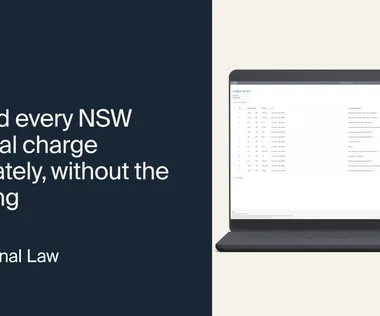
Enter one Law Part Code and LEAP fills in the section, Act and offence description from the Judicial Commission's database. Here's how the Criminal Charges table works, and how the AI fills it in from a Court Attendance Notice.
Keep up to date with LEAP Criminal Law
See the latest products created by the LEAP Criminal Law team.