Criminal Law
Legal Aid NSW EAGP changes: When counsel is funded before committal

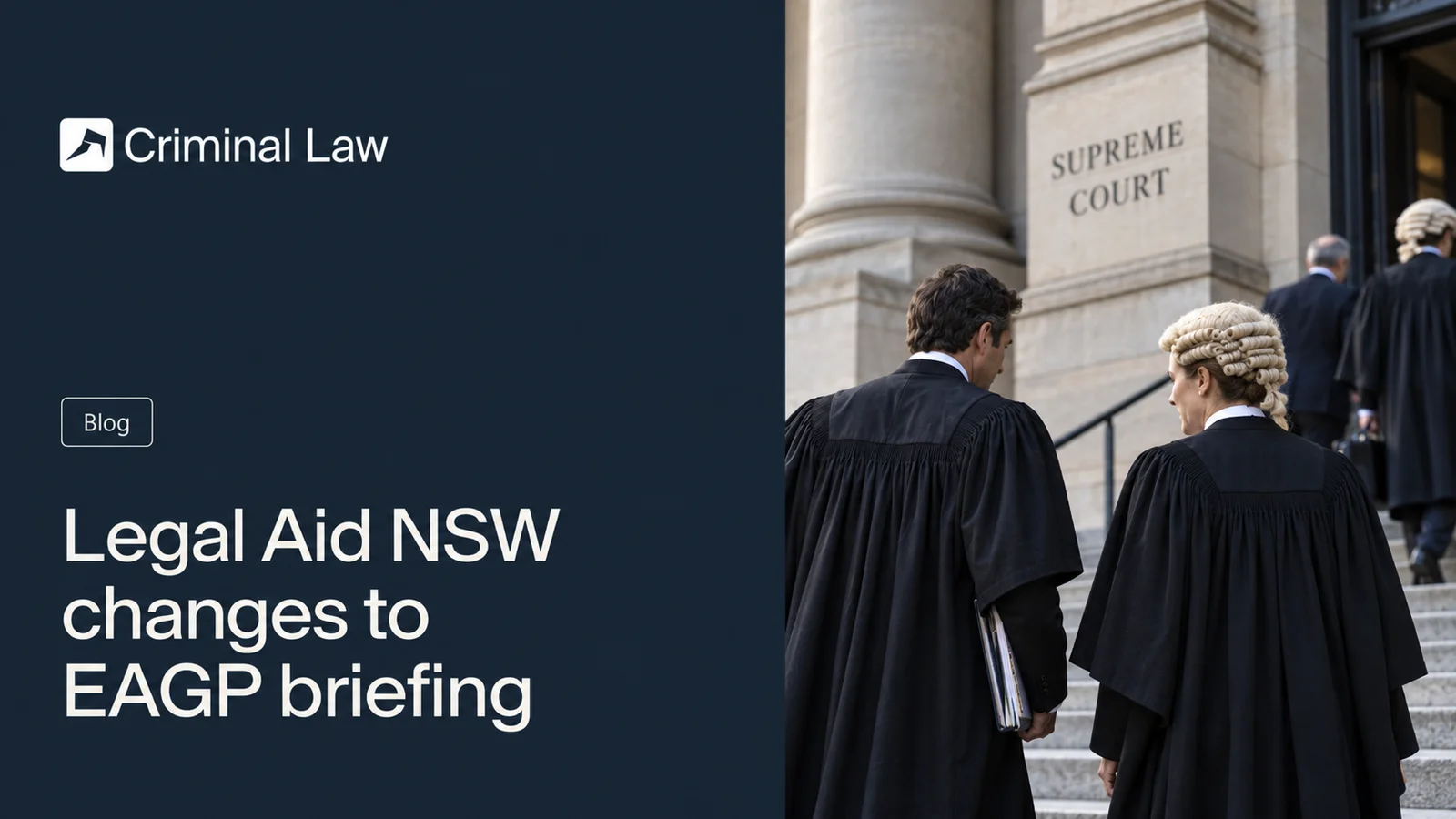
As part of Legal Aid NSW's 2026-27 July service and policy changes there are a number of changes that can affect practitioners. In particular for criminal law practitioners there has been a change in policy for briefing counsel in Early Appropriate Guilty Plea (EAGP) matters from 4 August 2026.
Relevant links
Disclaimer: The information provided in the articles in this section are of a general nature and should not be construed as specific advice or relied upon in lieu of appropriate professional advice. Whilst LEAP Legal Software uses commercially reasonably efforts to ensure the information in these articles are up to date at the time of publication, LEAP does not warrant their accuracy, currency or completeness and excludes all loss or damage howsoever arising (including through negligence) in connection with the information contained in these articles.
When Legal Aid NSW will fund counsel in EAGP matters before committal
From 4 August 2026 there are a number of changes to the circumstances where funding for counsel can be briefed in EAGP matters before committal:
the primary offence has a maximum penalty of 21 years imprisonment or more;
it will be a Supreme Court matter;
a fitness issue or mental health defence arises;
the matter involves the death of a person;
a Public Defender has the opinion that the client is highly vulnerable and has the capacity to accept the brief;
the defendant is a child charged with a serious children's indictable offence (defined in s 3 Children (Criminal Proceedings) Act 1987);
the matter involves sexual offences with multiple complainants and/or multiple defendants;
Child Sexual Offence Evidence Program (CSOEP) matters; and
the changes only apply to funding for counsel pre-committal. Where a matter has been committed to the District Court for trial or sentence, counsel can be briefed subject to existing policies and procedures.
Seeking a discretion in exceptional circumstances
There are circumstances where a discretion can be obtained to brief counsel outside of the above circumstances and the discretion should only be sought in exceptional circumstances. Legal Aid provided the following list as an example of complex matters:
nature of the charge or the defence (eg sex slavery matters, fraud/money laundering matters involving 30 or more counts and/or a value exceeding $500,000);
complex evidentiary issues; and
unusually difficult questions of law or evidence.
Approval for counsel outside the guidelines
Additionally matters that don't meet guidelines, approval for counsel pre-committal may be granted by the Solicitor in Charge, Grants Crime and those requests should be submitted as an extension request and include detailed reasons for engaging counsel. If practitioners believe there are discretionary grounds to brief counsel, approval can be sought for that discretion prior to the charge/s being certified and any prospective extension of a grant for counsel will only be given on the condition that the charge/s are certified.
Frequently asked questions
When do the Legal Aid NSW changes to EAGP briefing start?
From 4 August 2026. The changes only apply to funding for counsel pre-committal in Early Appropriate Guilty Plea (EAGP) matters.
Can counsel be briefed once an EAGP matter has been committed to the District Court?
Yes. Where a matter has been committed to the District Court for trial or sentence, counsel can be briefed subject to existing policies and procedures.
Can counsel be briefed in an EAGP matter outside the listed circumstances?
Only in exceptional circumstances. Approval for counsel pre-committal may be granted by the Solicitor in Charge, Grants Crime, and requests should be submitted as an extension request with detailed reasons for engaging counsel.
Can approval for counsel be sought before the charge is certified?
Yes. If there are discretionary grounds to brief counsel, approval can be sought prior to the charge/s being certified. Any prospective extension of a grant for counsel will only be given on the condition that the charge/s are certified.
About the writer

Related Articles
On 30 October 2026, the Victorian Court of Appeal handed down its decision in the Erin Patterson appeal and the DPP’s sentence appeal. Here is what the Court decided, and what it means for non-parole periods.
From 2027, three NSW District Courts will hold a ground rules hearing before the complainant gives evidence in adult sexual assault trials.
The NSW Court of Criminal Appeal revoked the guideline judgement of R v Whyte read what they've replaced it with.
Enter one Law Part Code and LEAP fills in the section, Act and offence description from the Judicial Commission's database. Here's how the Criminal Charges table works, and how the AI fills it in from a Court Attendance Notice.
Keep up to date with LEAP Criminal Law
See the latest products created by the LEAP Criminal Law team.